


By Yousuf Ibnul Hasan
Karachi is Pakistan’s financial capital, a city of ports, industries, commerce, opportunities and dreams. Yet if someone were asked to identify one of its fastest-growing informal industries, the answer might not be banking, real estate, information technology or exports. It could well be professional begging: an activity that requires little or no investment, no office, no licence, no tax return and, in some cases, generates daily earnings greater than those of people engaged in regular employment.
Islam teaches compassion, generosity and care for the poor. At the same time, it places great value on dignity, self-reliance and earning ones livelihood through lawful work. The Prophet Muhammad (peace be upon him) emphasized the virtue of the giving hand over the asking hand and encouraged people to earn through their own labour. Unfortunately, somewhere between genuine need, charity and convenience, begging in Karachi appears to have evolved from a social necessity into, in some cases, a well-organised and profitable profession.
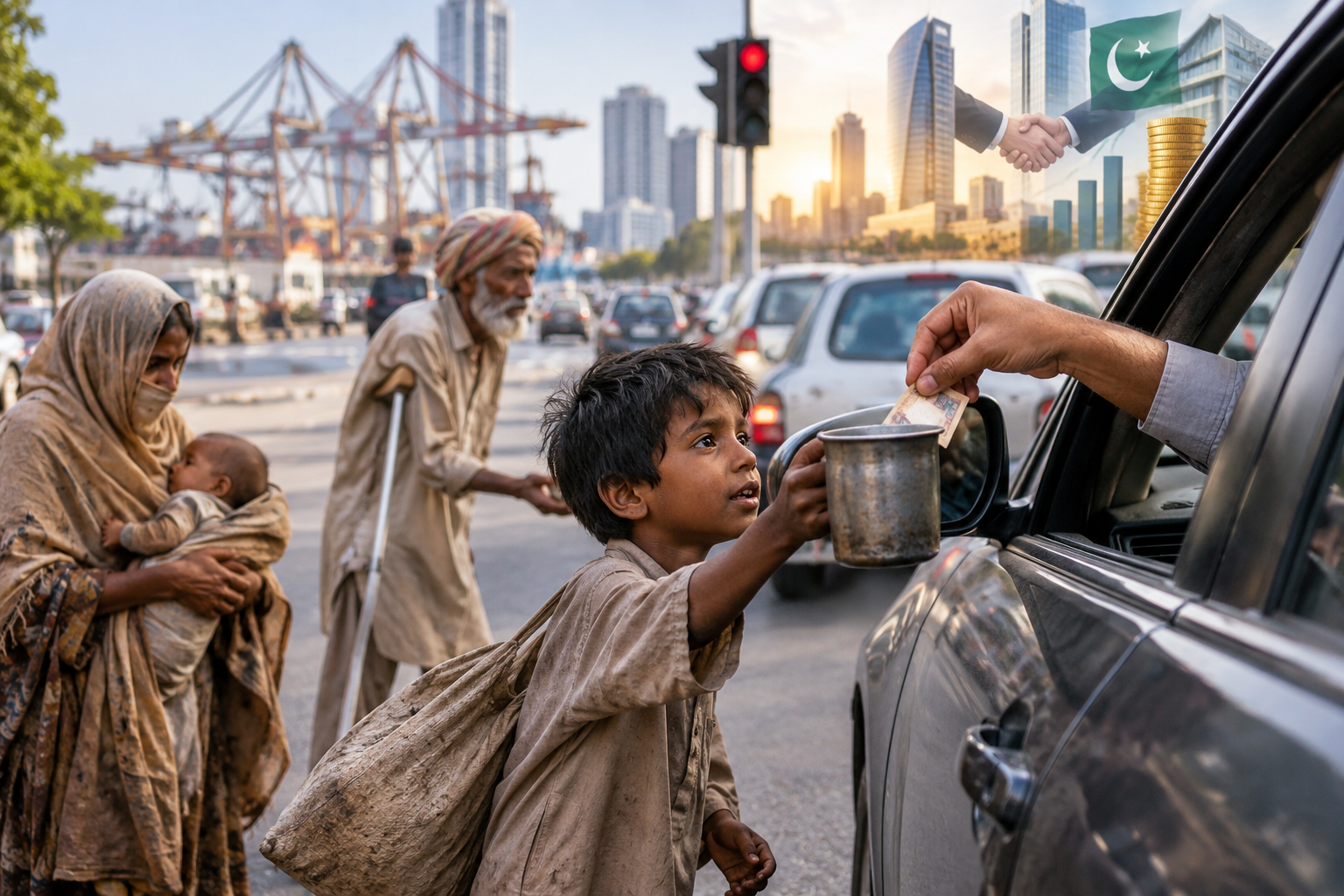
A visitor to Karachi soon discovers that the city has a unique traffic system. The red light tells motorists to stop, while the green light tells them to move before another emotional appeal reaches their car window.
At many major intersections, motorists encounter people carrying borrowed crutches, displaying bandages, holding sleeping children or presenting carefully rehearsed stories of hardship. By the time the traffic signal changes, the drivers wallet may be lighter, the conscience heavier and common sense still trying to understand what just happened.
Someone once jokingly described Karachi as having the worlds first Open-Air MBA Programme. Its degree? Master of Begging Administration, with specialisations in emotional marketing, customer psychology and rapid cash collection. The final examination takes place at busy traffic signals, where candidates must persuade motorists to donate before the light turns green.
Distinction marks, of course, go to those who manage to collect money from someone driving a twenty-year-old car while convincing him that he is among Karachis wealthiest citizens.
An old Karachi joke says: I change my car every five years, but the beggar at my traffic signal has recognised me for the last fifteen.
Another friend put it even more humorously: The only people who never forget your face are your mother and the beggar outside your favourite restaurant.
Behind the humour, however, lies a serious social problem.
If educational institutions demonstrated the same determination and consistency shown by some professional beggars, Pakistan might have one of the highest literacy rates in Asia. Their attendance is remarkably consistent. Rain or sunshine, scorching heat or political unrest, they often appear at their usual locations with impressive punctuality, sometimes before government offices have opened.
One cannot help wondering whether some organisations could learn something from their attendance-management system.
The irony becomes particularly painful when incomes are compared. A person handing over Rs50 may himself be struggling to pay school fees, electricity bills, petrol costs and taxes. Meanwhile, someone collecting money at a busy intersection may accumulate more cash before noon than many graduates earn after several days of honest work.
As the saying goes, The easiest business is one in which the customer thanks you after paying.
But the greatest victims of organised begging are not necessarily motorists. They are the genuinely deserving poor.
Every rupee given to an organised begging network is potentially one less rupee available to a widow, orphan, disabled person, deserving student or family facing genuine financial hardship. More disturbing still is the involvement of children.
Thousands of children risk learning the techniques of begging before they learn the alphabet. Their classrooms become traffic intersections. Their textbooks are replaced by emotional stories, and their performance is measured not through examinations but by the amount of money collected during the day.
This is where society must draw a clear distinction between poverty and exploitation.
Karachi’s generosity is legendary. Whenever floods, earthquakes, disasters or national emergencies strike, its citizens respond with open hearts and open wallets. But generosity without verification can sometimes have unintended consequences. Instead of alleviating poverty, poorly directed charity may finance exploitation and encourage dependency.
Charity becomes most effective when compassion is combined with wisdom.
Street crime has made the situation even more complicated. Today, every knock on a car window can raise an uncomfortable question: Is this person genuinely hungry, or is the distraction being used to create an opportunity for someone else to snatch a mobile phone, purse or other valuable?
When trust disappears, the genuinely needy suffer most because society begins to suspect everyone.
Imagine a tourist arriving in Karachi. Before reaching the hotel, he may encounter more fundraisers than tour guides. If travel websites ever introduced a category for traffic-signal fundraising, Karachi might receive five stars for hospitality, five stars for generosity and perhaps six stars for entrepreneurial persistence.
Perhaps one day historians will write:
Karachi was a city where some professionals did not need business cards because every traffic signal served as their office address.
The point, however, is not to ridicule charity.
Charity is one of the great virtues of Islam, and helping someone in genuine need is a moral responsibility. The real challenge is ensuring that assistance reaches those who genuinely deserve it.
A scholarship can be more valuable than spare change. A sewing machine can be more empowering than sympathy. Vocational training can be more sustainable than temporary assistance. And a dignified job is far better than a lifetime spent holding out a begging bowl.
Karachi deserves traffic signals where motorists stop because the light is red, not because ten hands suddenly appear outside their windows.
It deserves streets where children carry schoolbags instead of begging bowls. It deserves opportunity instead of organised dependency, dignity instead of exploitation and employment instead of emotional manipulation.
There is a famous proverb:
Give a man a fish and you feed him for a day; teach him how to fish and you feed him for a lifetime.
For decades, Pakistan has often focused on distributing fish. Perhaps the time has come to build more fishing boats.
And now for one final smile, and a serious lesson.
Someone once remarked:
If hard work made people poor, the donkey would be the poorest animal on earth. But if begging made nations prosperous, Karachi would already be the richest city in Asia.
The joke may make us laugh, but its message deserves serious thought.
The honour of a society should not be measured by the number of hands stretched out for money, but by the number of hands empowered to earn it.
From Traffic Signals to the Corridors of Power
There is another irony that deserves reflection. Perhaps our national habit of asking did not begin at the traffic signal. Perhaps it eventually reached the corridors of power.
Pakistan was not always viewed as a country dependent on external financial assistance. During periods of rapid economic growth in the late 1950s and 1960s, Pakistan was regarded as one of Asias promising economies. It even provided technical assistance and support to countries that are today considered among the worlds more developed nations.
There was a time when many believed Pakistan could become the next Asian Tiger.
Over the decades, however, borrowing often became easier than undertaking difficult structural reforms. Development increasingly became associated with foreign loans, grants and aid packages. The pursuit of external assistance gradually began to overshadow the harder task of building a genuinely self-reliant economy.
Today, every new loan can sometimes be presented as an economic achievement, while the responsibility for repayment quietly moves to future generations.
This raises an uncomfortable question: after decades of borrowing, where is the visible transformation that such enormous financial inflows should have produced?
Our roads, schools, hospitals, industries, infrastructure and public services should have reflected the scale of investment associated with such borrowing. Yet the national debt continues to weigh heavily on the economy, while sustainable prosperity remains an unfinished objective.
A satirist might therefore conclude that the beggar at the traffic signal and the nation at the negotiating table share one unfortunate characteristic: both are waiting for someone else to solve tomorrows problems.
The difference, of course, is that the traffic-signal beggar may ask for fifty rupees, while governments negotiate in billions.
The real challenge for Karachi, and for Pakistan, is not merely to stop people from asking. It is to create a society in which people have meaningful opportunities to earn.
Because the ultimate goal should not be a society with fewer begging bowls.
It should be a society that no longer needs them.
(The columnist is a Program Consultant in Islamic Banking and Applied Finance, teacher, trainer, author, banker and broadcaster. He can be reached at: pride4pen@gmail.com)