



By: Shahid Anwar
Pakistan spent decades trying to solve an electricity shortage. The next economic challenge is different: How do we ensure that the electricity we produce translates into factories, exports, investment and jobs?
Pakistan’s energy debate has entered a new phase. For years, the focus was on overcoming load shedding and expanding generation capacity. Significant investments were made in the power sector, and the country moved away from the era of severe electricity shortages. However, energy policy cannot be measured only by megawatts added. The real economic value of electricity comes when it supports productive activity i.e. when factories expand, exports grow, businesses invest and employment increases.
The central question today is simple yet fundamental: Can Pakistan convert electricity capacity into industrial capacity?
From Power Availability to Economic Utilization
According to the National Electric Power Regulatory Authority (NEPRA), Pakistan’s installed generation capacity has crossed 45,000 MW, reflecting substantial investment in the power sector. However, demand growth has not increased at the same pace, creating challenges related to capacity utilization, affordability and financial sustainability. (Source: NEPRA State of Industry Report 2024).
This represents a fundamental shift in Pakistan’s energy challenge. The country’s earlier problem was insufficient supply. The emerging challenge is ensuring that available power contributes to economic growth. A power system becomes economically valuable when electricity is used productively. One megawatt supplying a productive factory creates industrial output, exports, employment and tax revenues. However, when capacity growth exceeds demand growth, the fixed-cost burden increases and affects overall electricity affordability.
The Financial Challenge of the Power Sector
Pakistan’s power sector continues to face structural financial pressures. Circular debt remains a major challenge due to multiple factors, including transmission and distribution losses, inefficiencies, delayed payments and capacity-related costs. The Power Division Circular Debt Report September 2025 reported power sector circular debt of around Rs. 1.7 trillion, highlighting the need for deeper structural reforms. (Source: Ministry of Energy, Power Division Circular Debt Report September 2025).
The objective of reform should therefore not only be reducing financial losses, but also increasing productive demand for electricity. The cheapest electricity for the economy is not necessarily the electricity that is produced at the lowest cost; it is the electricity that creates the highest economic value.
The IPP Debate: A Lesson for Future Planning
The discussion around Independent Power Producers (IPPs) requires a balanced economic assessment. IPPs played an important role in Pakistan’s economic journey by helping overcome severe electricity shortages and increasing generation capacity when the country faced a supply crisis. However, many agreements were designed during a period when the priority was increasing electricity availability. With slower demand growth and weaker industrial expansion, the fixed-cost structure of the power sector became a challenge.
The lesson is not that investment in generation capacity was unnecessary. The lesson is that energy planning must remain aligned with economic growth, industrial expansion and future demand creation. Future power policies must therefore focus not only on adding capacity but also on creating the economic conditions that allow that capacity to be productively utilized.
Why Has Industrial Electricity Demand Remained Under Pressure?
High energy costs and competitiveness concerns. For industry, electricity is not simply an operating expense; it is a major determinant of competitiveness. For an export-oriented economy, electricity cost is not only a domestic issue. It directly influences whether Pakistani products can compete in global markets. High and unpredictable energy costs can discourage investment, delay expansion and reduce competitiveness.
Growth of captive power and alternative energy. Many industries adopted captive generation and solar solutions to manage cost and reliability concerns. The rapid expansion of rooftop solar reflects businesses’ search for affordable and dependable energy solutions. The challenge is not to discourage renewable energy, but to build a modern grid where renewable sources complement a financially sustainable power system. (Source: International energy market analysis and reporting, including Reuters coverage of Pakistan’s rooftop solar expansion).
Limited industrial expansion. Electricity demand is ultimately driven by economic activity. A country with expanding manufacturing, exports and investment naturally consumes more electricity. Therefore, improving industrial electricity demand requires policies that encourage businesses to grow.
From Energy Policy to Industrial Policy
Pakistan now needs to move from a supply-focused energy strategy towards a growth-oriented energy strategy. The objective should not simply be higher electricity consumption. The objective should be more productive electricity consumption.
A practical policy framework should include an Industrial Energy Competitiveness Framework, under which energy policies should be evaluated against economic outcomes including export growth, industrial investment, employment creation and productivity improvement. It should also provide Predictable Industrial Energy Pricing, because businesses make long-term investment decisions based on certainty. Temporary tariff relief should evolve into a predictable and competitive industrial energy framework.
Similarly, Performance-Based Incentives should support industries that increase exports, create jobs, improve efficiency and move towards higher value-added production. Energy-Competitive Industrial Zones should offer more than tax incentives by providing reliable electricity, competitive tariffs and efficient infrastructure. Finally, future generation and transmission decisions should be linked with industrial policy, export strategy and investment priorities so that future power planning remains aligned with Pakistan’s broader economic strategy.
The Way Forward
Pakistan’s next energy transition should not only be from shortage to surplus. It should be from surplus capacity to productive capacity. The success of Pakistan’s power sector should not be measured only by megawatts added. The real measures should be:
How many industries expanded?
How much did exports grow?
How many jobs were created?
How much productivity improved?
Pakistan does not need electricity consumption for its own sake. It needs electricity that creates economic value.
The next power sector reform should not only create electricity. It should create growth.
[The writer is an Economic Analyst and former Secretary General of the Federation of Pakistan Chambers of Commerce and Industry (FPCCI). He has also served as Senior Director Research at the Institute of Cost and Management Accountants of Pakistan (ICMAP). He can be reached atshahid.anwar.writer.26@gmail.
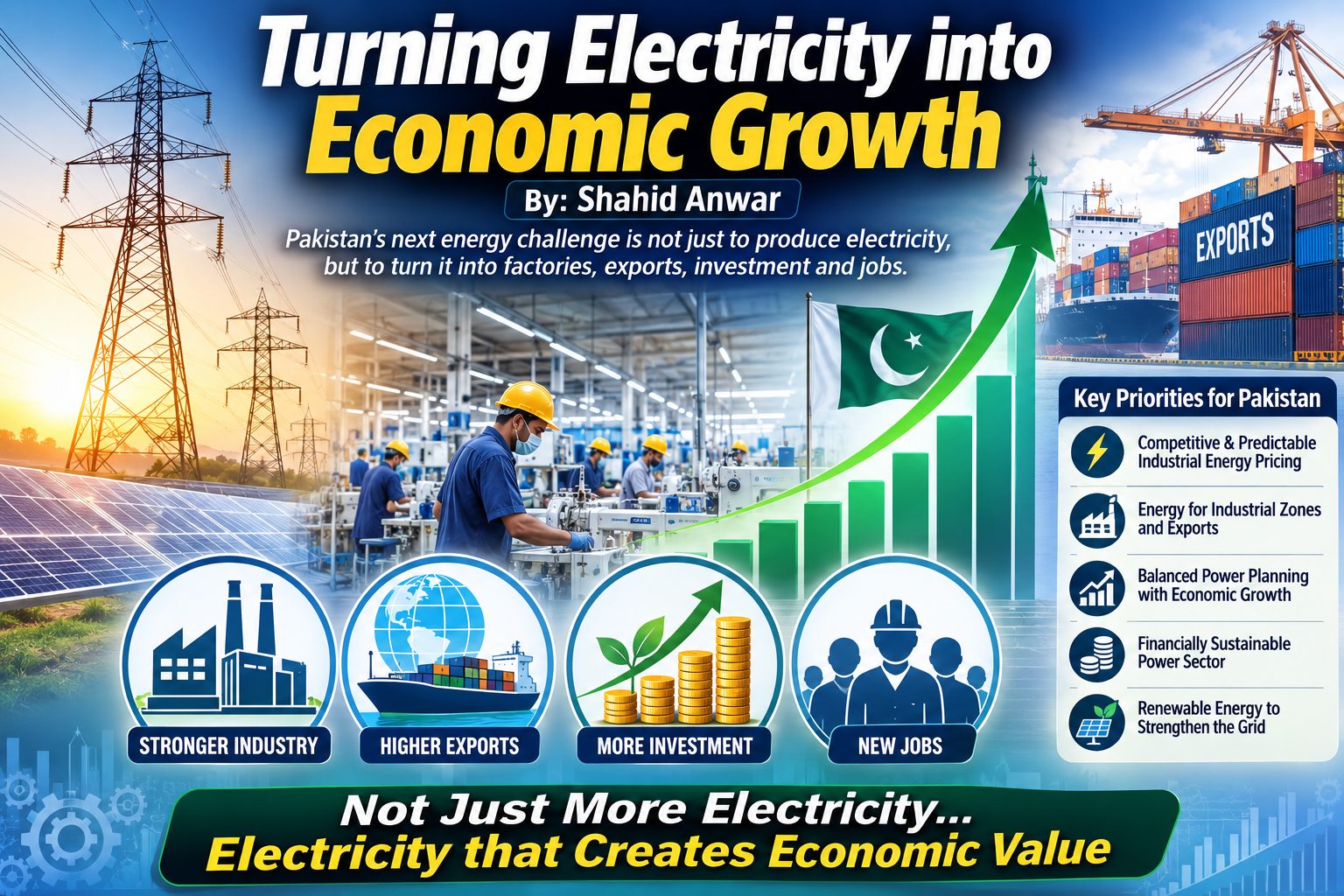
The accompanying image isAI-generatedand is intended solely for illustrative purposes.