

By Yousuf Ibnul Hasan
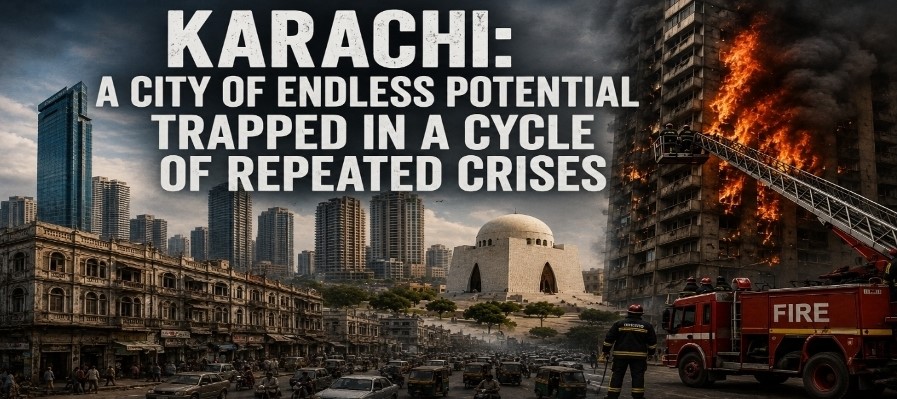
Imagine living in a high-rise building where a safety incident has already claimed human lives. One day, a devastating fire engulfs several floors. On another, emergency exits are found locked or blocked. Fire alarms fail to sound, sprinkler systems do not function, and rescue teams struggle to reach trapped occupants because the building was never designedor maintainedwith adequate safety measures.
After every disaster, the pattern is painfully familiar. Public outrage erupts. Authorities announce investigations. Building owners express regret. Officials promise stricter enforcement of safety regulations. Yet, once public attention fades, business returns to normaluntil the next tragedy strikes.
This raises an unavoidable question: Are these merely unfortunate accidents, or are they the inevitable consequences of a much deeper and systemic failure?
A Skyline Rising Faster Than Safety Standards
As Karachi’s population, commercial activity and demand for urban space have expanded, the city has witnessed rapid growth in high-rise construction. Soaring land prices and intense demand for residential and commercial space have transformed the skyline at an unprecedented pace.
High-rise development is not inherently a problem. In fact, well-planned vertical development can make efficient use of scarce urban land and support a modern metropolitan economy. The real problem arises when construction expands faster than the systems responsible for planning, inspection, enforcement, emergency response and public safety.
In a competitive construction market, cost reduction and profit maximisation can create dangerous incentives. When essential safety features are treated as unnecessary expenses rather than mandatory requirements, the consequences can be catastrophic.
Many buildings may lack adequate fire escapes, modern fire-suppression systems, functioning alarms, emergency evacuation plans, sufficient parking and reliable access for firefighting vehicles. In some cases, buildings may be approved despite violations of applicable regulations, while others undergo unauthorised alterations after completion.
As occupancy increases, the pressure on already inadequate infrastructure becomes even greater, placing thousands of residents, workers and visitors at risk.
When a Building Becomes a Death Trap
The consequences of inadequate safety standards are devastating.
A fire that might have been contained in a properly designed and maintained building can quickly become a major catastrophe when emergency systems fail. Narrow staircases, blocked exits, malfunctioning alarms, overcrowded floors and inaccessible building approaches can turn a high-rise into a deadly trap.
Instead of providing secure spaces for families and businesses, such structures can become vertical death traps, where survival depends more on luck than preparedness.
Every neglected inspection, every ignored building code and every compromise made in pursuit of greater profit increases the probability of another disaster.
Karachi deserves buildings that represent progress, investment and prosperitynot towering monuments to negligence and preventable loss of life.
The Warnings of Ardeshir Cowasjee
The late Ardeshir Cowasjee, one of Karachi’s most outspoken civic voices, spent decades highlighting the relationship between unscrupulous development practices and ineffective regulatory enforcement.
I vividly recall an incident in which he challenged a building project in Clifton over alleged safety and regulatory violations. After losing the case in the Sindh High Court, he reportedly endured taunts and abusive remarks from those who celebrated the verdict. With tears in his eyes, he is remembered as saying, in substance, that if the law were applied honestly, the issue would extend far beyond a single building.
Whether or not one agrees with the scale of his assessment, the message behind Cowasjee’s criticism remains relevant. He believed that unchecked commercialisation of Karachi’s skyline had come at too high a price.
His central concern was not simply the construction of buildings. It was the culture surrounding construction: regulatory violations, inadequate enforcement, official negligence and the belief that economic interests could take precedence over public safety.
Cowasjee repeatedly warned that unless this culture of impunity ended, Karachi’s high-rises could become symbols not of modernity and progress, but of regulatory failure and preventable human tragedy.
Karachi’s Transformation After 1947
To understand Karachi’s present crisis, it is necessary to understand how the city evolved.
Pakistan’s independence in 1947 marked a defining moment in Karachi’s history. The city became the country’s first federal capital and housed the Federal Secretariat, the Constituent Assembly and the Governor-General’s House. For several years, Karachi served as both the political and administrative centre of the new nation.
At the same time, one of the largest migrations in South Asian history transformed the city. Karachi’s population increased dramatically, rising from roughly 400,000 in 1941 to more than one million by 1951.
The newcomers were not simply additional residents. They included professionals, traders, educators, entrepreneurs and skilled workers who made major contributions to Karachi’s economy, culture and commercial identity.
But the city’s infrastructure was not designed to accommodate such rapid growth. Housing, roads, water supply, sanitation, transport and other public services soon came under enormous pressure.
When Pakistan decided to relocate its capital in 1959, Rawalpindi served temporarily before Islamabad was developed as the permanent federal capital. By 1967, government ministries, Parliament and foreign embassies had largely moved out of Karachi.
Karachi remained the country’s commercial and financial powerhouse, but it lost its political and administrative centrality.
This transition had long-term consequences. As the city continued to generate enormous economic value, governance responsibilities became increasingly distributed among multiple institutions and jurisdictions. Fragmentation created overlapping responsibilities, weakened coordination and, in many cases, diluted accountability.
The Economic Paradox
Despite decades of governance challenges, Karachi remains Pakistan’s largest commercial and industrial centre.
The Pakistan Stock Exchange represents the country’s principal capital market, while banks, logistics companies, exporters, manufacturers, traders and service providers connect Pakistan with markets across Asia, the Middle East, Europe and beyond.
Billions of rupees circulate through Karachi’s economy every day. The city generates employment, attracts investment and contributes substantially to national revenues.
Yet this economic importance creates a profound paradox:
How can the city that generates so much of Pakistan’s wealth continue to suffer from recurring urban disasters, deteriorating infrastructure, inadequate civic services and persistent governance failures?
The answer cannot be found in Karachi’s economic potential. It lies in decades of weak urban planning, fragmented administrative control, regulatory shortcomings, inadequate enforcement and a development model that has too often placed short-term commercial interests ahead of public safety and long-term urban sustainability.
A City Slowly Consumed From Within
Today, Karachi’s decline resembles a building silently weakened by termites.
At first, the damage may be barely visible. A leaking water pipe here. A broken road there. An encroachment somewhere else. A dysfunctional drainage system. A delayed infrastructure project. A building code violation that goes unaddressed.
But year after year, these seemingly minor failures accumulate. Eventually, the entire urban structure becomes vulnerable.
Karachi’s deterioration has not occurred overnight. Repeated fires, building collapses, flooding, water shortages, traffic congestion, pollution, environmental degradation, inadequate public transport, law-and-order concerns and failures in municipal services are not independent events.
They are symptoms of deeper structural weaknesses accumulated over decades.
Responding only after each crisis does not solve the problem. It merely postpones the next crisis.
The Entrepreneurial Spirit That Built Karachi
The history of Karachi’s economic development also reflects the extraordinary contribution of migrants who arrived after Partition.
Many brought professional expertise, entrepreneurial skills, industrial knowledge, commercial experience and private capital. Through determination and hard work, they established industries, trading houses, educational institutions and commercial enterprises.
Their efforts helped transform Karachi into one of South Asia’s important economic centres and created employment opportunities for millions.
Later economic policies, including the nationalisation of industries during the 1970s, significantly altered the relationship between the state and private enterprise. The economic and social consequences of those policies remain subjects of historical debate. Nevertheless, there is little doubt that Karachi’s private sector and entrepreneurial environment underwent profound changes during that period.
The broader lesson is clear: cities thrive when entrepreneurship, investment, infrastructure, security, competent governance and predictable regulation reinforce one another.
Karachi Needs More Than Promises
Karachi requires more than periodic announcements, temporary projects and post-disaster investigations. It requires a sustained national commitment.
Saving Karachi is not merely a provincial responsibility. It is a national economic imperative.
A city that contributes so significantly to Pakistan’s economy deserves governance that matches its strategic importance.
Pakistan should consider a long-term, professionally managed urban transformation strategy that rises above political cycles and places merit, accountability, public safety, infrastructure, environmental protection and modern city management at its core.
The Case for a Karachi Capital Authority
One possible institutional solution is the creation of an autonomous Karachi Capital Authority, established through the appropriate constitutional and legal framework and given clearly defined administrative responsibilities.
Such an authority should have professional leadership, transparent accountability, measurable performance targets and sufficient continuity to implement policies over at least a decade.
Its responsibilities could include:
- enforcing building and fire-safety regulations;
- coordinating urban planning and development approvals;
- restoring and maintaining critical infrastructure;
- improving public transportation;
- strengthening emergency-response systems;
- ensuring reliable water, sanitation and drainage services;
- protecting public land and civic assets;
- improving urban environmental management;
- facilitating responsible investment;
- coordinating law-enforcement and public-safety agencies; and
- establishing transparent systems for inspection, licensing and accountability.
Such an institution should not become another layer of bureaucracy. Its purpose must be precisely the opposite: to reduce fragmentation, establish clear responsibility and ensure that someone is ultimately accountable for the city’s performance.
Any such reform would require broad political consensus and must operate fully within Pakistan’s constitutional and legal framework.
From Crisis Management to City Management
Karachi does not need another cycle in which disaster occurs, outrage follows, committees are formed, reports are prepared and attention eventually disappears.
The city needs prevention.
Every high-rise should be treated as a potential community of hundreds or thousands of people whose safety cannot depend on paperwork alone. Building approvals must be followed by meaningful inspections. Fire exits must remain accessible. Fire alarms and suppression systems must function. Emergency routes must be usable. Firefighting equipment must be able to reach buildings. Occupancy limits must be respected. Illegal alterations must be identified and stopped.
Most importantly, responsibility must be traceable.
If a building violates safety standards, the question should not end with identifying the violation. Authorities must determine who approved it, who inspected it, who altered it, who ignored warnings and who ultimately bears responsibility for allowing the risk to continue.
Karachi’s Future Is Pakistan’s Future
Karachi’s skyline will continue to grow. The choice before us is whether that growth will be accompanied by stronger institutions, safer buildings, better infrastructure and accountable governanceor whether the city will continue to expand while its foundations weaken.
Economic development without public safety is not sustainable development.
High-rise buildings without effective fire protection are not symbols of progress.
Infrastructure without maintenance is not development.
And governance without accountability cannot produce a safe and prosperous city.
Karachi has the human capital, entrepreneurial energy, financial importance and strategic location to become one of Asia’s most dynamic metropolitan centres. What it lacks is not potential, but consistent, professional and accountable urban governance.
The time for temporary solutions has passed.
The time has come for bold, visionary and sustained action.
Save Karachi to Save Pakistan.
A stronger Karachi means a stronger national economy, greater investment, improved employment opportunities, enhanced urban resilience and a better future for generations to come.
Karachi was once proudly known as the City of Opportunity and the economic lifeline of Pakistan. With the right leadership, institutions and long-term commitment, it can become so againbut only if human life, public safety and good governance are placed above short-term profit and political convenience.
The skyline must risebut so must the standards that keep the people beneath it safe.
(The columnist is a Program Consultant in Islamic Banking and Applied Finance, teacher, trainer, author, banker and broadcaster. He can be reached at: pride4pen@gmail.com)