

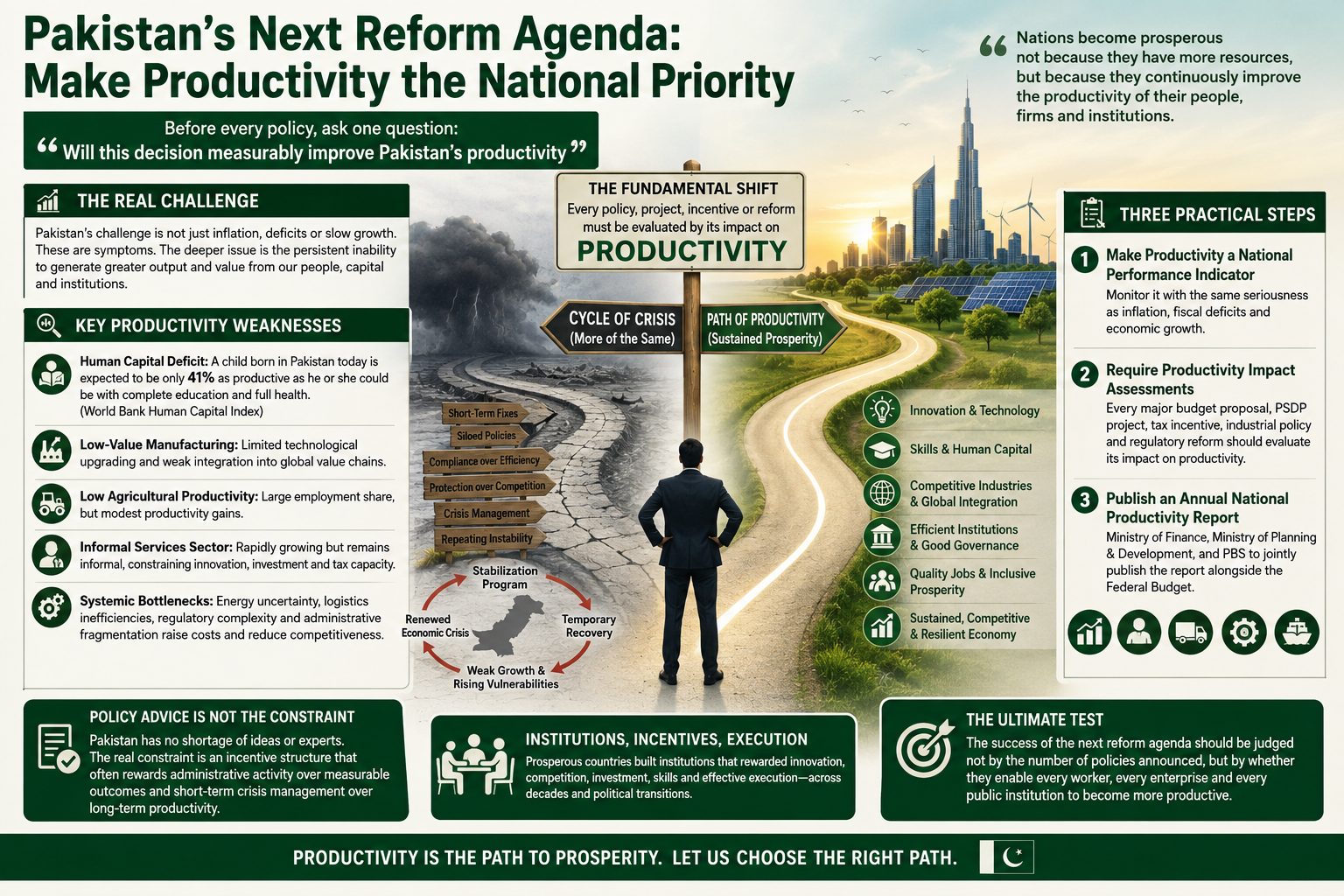

Pakistan’s next phase of economic reform should begin with a simple but fundamental shift in thinking. Before announcing another industrial package, tax measure, subsidy, incentive or development project, the government should ask one question:
Will this decision measurably improve Pakistan’s productivity?
If the answer is unclear, its long-term contribution to economic prosperity is likely to be limited, regardless of its short-term political or fiscal appeal.
This question matters because Pakistan’s real economic challenge is not merely inflation, fiscal deficits, external imbalances or slow growth. These are symptoms. The deeper challenge is the economy’s persistent inability to generate greater output and value from its people, capital and institutions.
As an economic analyst, I believe Pakistan has become increasingly efficient at managing economic crises but far less successful at preventing them. Stabilization programs restore macroeconomic order, but they rarely transform the underlying drivers of economic performance. Consequently, each recovery is followed by another period of weak growth, declining competitiveness and renewed economic stress.
Economic history leaves little room for doubt. Nations become prosperous not because they possess greater natural resources or larger populations, but because they continuously improve the productivity of their workers, firms and institutions. Productivity determines wages, exports, investment, innovation and, ultimately, national prosperity.
Measured against this benchmark, Pakistan’s long-standing weaknesses are difficult to ignore.
According to the World Bank’s Human Capital Index, a child born in Pakistan today is expected to be only about41 percent as productiveas he or she could be with complete education and full health. This reflects persistent deficiencies in learning outcomes, nutrition, healthcare and skills developmentconstraints that begin long before individuals enter the labour market.
Manufacturing remains concentrated in relatively low-value production with limited technological upgrading and insufficient integration into global value chains. Agriculture continues to employ a large share of the labour force while generating comparatively modest productivity gains. The services sector has expanded rapidly but remains heavily informal, restricting innovation, investment and tax capacity.
Equally important, many of the systems that should enhance productivity instead impose additional costs. Energy uncertainty, logistical bottlenecks, regulatory complexity and administrative fragmentation continue to reduce competitiveness and discourage long-term private investment.
None of these realities are new.
Successive governments, international financial institutions, business organizations and independent economists have documented these challenges for years. Policy advice has never been Pakistan’s principal constraint.
The more relevant question is why these weaknesses continue to outlive successive governments, changing political priorities and repeated reform programs.
The answer lies less in economics than in political economy.
The country has developed considerable expertise in preparing reform agendas. It has been far less successful in building institutions and incentive systems capable of implementing those reforms consistently over time.
Policies are frequently designed in sectoral silos, even though productivity depends on coordination across the entire economy. Ministries pursue individual mandates while accountability for economy-wide productivity outcomes remains fragmented. Targets are announced, but institutional incentives to achieve them remain weak. Political transitions interrupt continuity, while annual fiscal pressures repeatedly displace long-term competitiveness as a national priority.
In other words, Pakistan’s economy is constrained not by a shortage of ideas but by an incentive structure that too often rewards administrative activity over measurable outcomes, compliance over efficiency, protection over competition, and short-term crisis management over long-term productivity.
This distinction is particularly important at the present stage of economic stabilization.
Fiscal consolidation, improved tax administration, energy sector reforms and prudent external account management are essential for restoring macroeconomic stability. These measures deserve continued commitment. However, stabilization should not be confused with transformation.
Pakistan has now reached an important policy inflection point. As macroeconomic stability gradually returns, the country has a rare opportunity to shift its focus from crisis management to structural transformation. If this window is not used to improve productivity, competitiveness and institutional efficiency, Pakistan risks repeating its familiar cycle of temporary recovery followed by renewed economic stress.
A country can reduce inflation, narrow fiscal deficits and rebuild foreign exchange reserves while remaining trapped in a low-productivity equilibrium. Macroeconomic stability creates the conditions for growth, but productivity determines whether that growth becomes sustained, inclusive and internationally competitive.
Without a sustained improvement in productivity, Pakistan is unlikely to achieve durable export growth, generate sufficient high-quality jobs for its expanding workforce, broaden its tax base or reduce recurring dependence on external financing. Macroeconomic stability may improve periodically, but long-term prosperity will remain elusive.
The next phase of reform should therefore place productivity at the center of economic
policymaking rather than treating it as one objective among many.Three practical steps could help initiate this shift.
First, the federal government should adopt productivity as a national economic performance indicator, monitored with the same seriousness as inflation, fiscal deficits and economic growth. What governments measure consistently is what they ultimately improve.
Second, every major budget proposal, PSDP project, tax incentive, industrial policy and significant regulatory reform should be accompanied by aProductivity Impact Assessment, evaluating its likely effects on competitiveness, value addition, technological upgrading, employment quality and export potential. Fiscal impact assessments have become routine; productivity assessments should now become equally important.
Third, the Ministry of Finance, the Ministry of Planning and Development, and the Pakistan Bureau of Statistics should jointly publish anAnnual National Productivity Reportalongside the Federal Budget. The report should track labour productivity, sectoral productivity, human capital outcomes, logistics efficiency, innovation, regulatory performance and export sophistication. Policymakers cannot systematically improve what they do not systematically measure.
Economic history offers a remarkably consistent lesson. Countries that transformed themselves did not merely produce better policy documents. They built institutions that rewarded innovation, competition, investment, skills and effective execution over decades, irrespective of political transitions.
Pakistan has no shortage of capable entrepreneurs, skilled professionals or policy expertise. Its greatest challenge is creating an institutional environment where productivity becomes the organizing principle of public policy rather than an incidental outcome of economic reform.
The question before policymakers is no longer whether Pakistan needs another reform agenda. The real question is whether the country’s institutions are prepared to reward productivity as consistently as they reward compliance and crisis management.
Until that question is answered through measurable institutional change, Pakistan is likely to continue moving from one stabilization program to another, achieving periodic macroeconomic stability without securing lasting economic transformation.
The success of the country’s next reform agenda should therefore be judged not by the number of policies announced, but by whether they enable every worker, every enterprise and every public institution to become more productive.
That, more than any macroeconomic indicator, will determine whether Pakistan finally breaks free from its recurring cycle of economic crises and embarks on a path of sustained, competitive and inclusive prosperity.
[The writer is an Economic Analyst and former Secretary General of the Federation of Pakistan Chambers of Commerce and Industry (FPCCI). He has also served as Senior Director Research at the Institute of Cost and Management Accountants of Pakistan (ICMAP). He can be reached atshahid.anwar.writer.26@gmail.