

By Shahid Anwar
Pakistan’s economic debate during every budget season typically revolves around taxes, inflation, electricity tariffs, interest rates, exchange rates, and IMF programs. While these issues are important for managing the current economy, a more fundamental question often receives far less attention: What should Pakistan produce to build a stronger economy for the future?
According to economic analyst Shahid Anwar, every successful industrial economy answers this question through a clear and long-term industrial strategy. Countries such as South Korea, China, Vietnam, and Bangladesh did not become manufacturing powerhouses by chance. Their success was built on well-designed industrial policies that encouraged investment, innovation, skills development, and integration into global value chains.
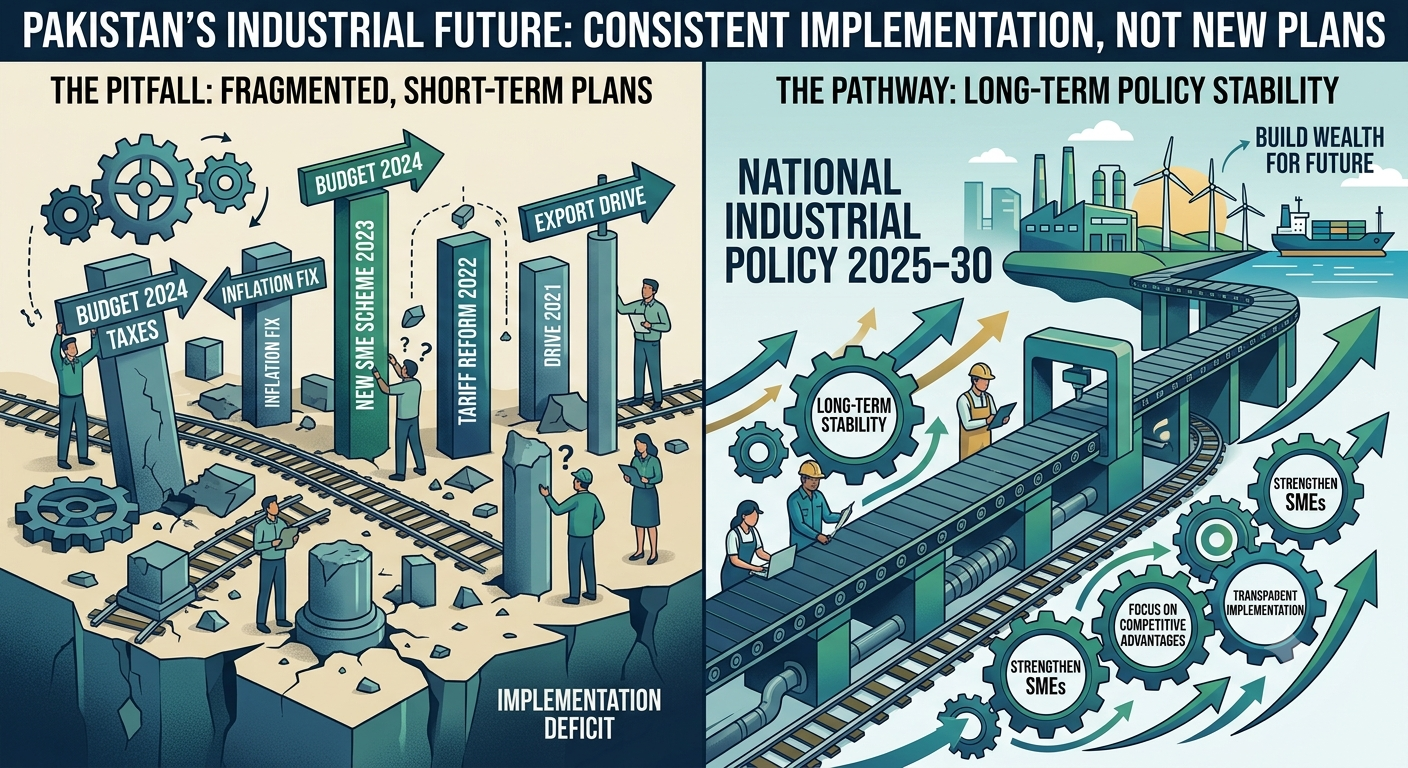
Pakistan’s proposed National Industrial Policy 202530 is viewed as a positive step toward strengthening manufacturing, increasing exports, and creating quality employment opportunities. However, the writer argues that the country’s greatest challenge has never been the lack of policy ideas, but the inability to implement them consistently.
Over the years, Pakistan has introduced numerous industrial strategies, export promotion frameworks, SME development programs, and investment initiatives. Many were well-designed, yet few delivered their intended results due to changing governments, shifting priorities, weak institutional coordination, and inconsistent implementation.
The article stresses that Pakistan suffers more from an implementation deficit than a policy deficit. The real measure of success will be whether industrial reforms influence investment decisions, improve manufacturing competitiveness, and boost exports.
To ensure successful industrial transformation, the writer recommends four key priorities:
- Maintain long-term policy stability so investors can plan with confidence.
- Focus government support on industries where Pakistan has genuine competitive advantages.
- Strengthen small and medium-sized enterprises (SMEs) through improved access to finance, technology, simplified regulations, and integration into global supply chains.
- Establish transparent implementation mechanisms with measurable targets, annual progress reports, and independent performance evaluations.
Pakistan possesses significant strengths, including a young workforce, entrepreneurial businesses, a strategic geographic location, and a large domestic market. However, sustained economic transformation requires consistent policies rather than frequent policy changes.
The article concludes that while budgets determine how governments spend money, industrial policy determines how nations generate wealth. Pakistan’s economic future will depend less on announcing new policies and more on implementing existing reforms with consistency, credibility, and long-term commitment.
(The writer is an Economic Analyst and former Secretary General of the Federation of Pakistan
Chambers of Commerce and Industry (FPCCI). He has also served as Senior Director Research at the
Institute of Cost and Management Accountants of Pakistan (ICMAP). He can be reached at
shahid.anwar.writer.26@gmail.