

By Yousuf Ibnul Hasan
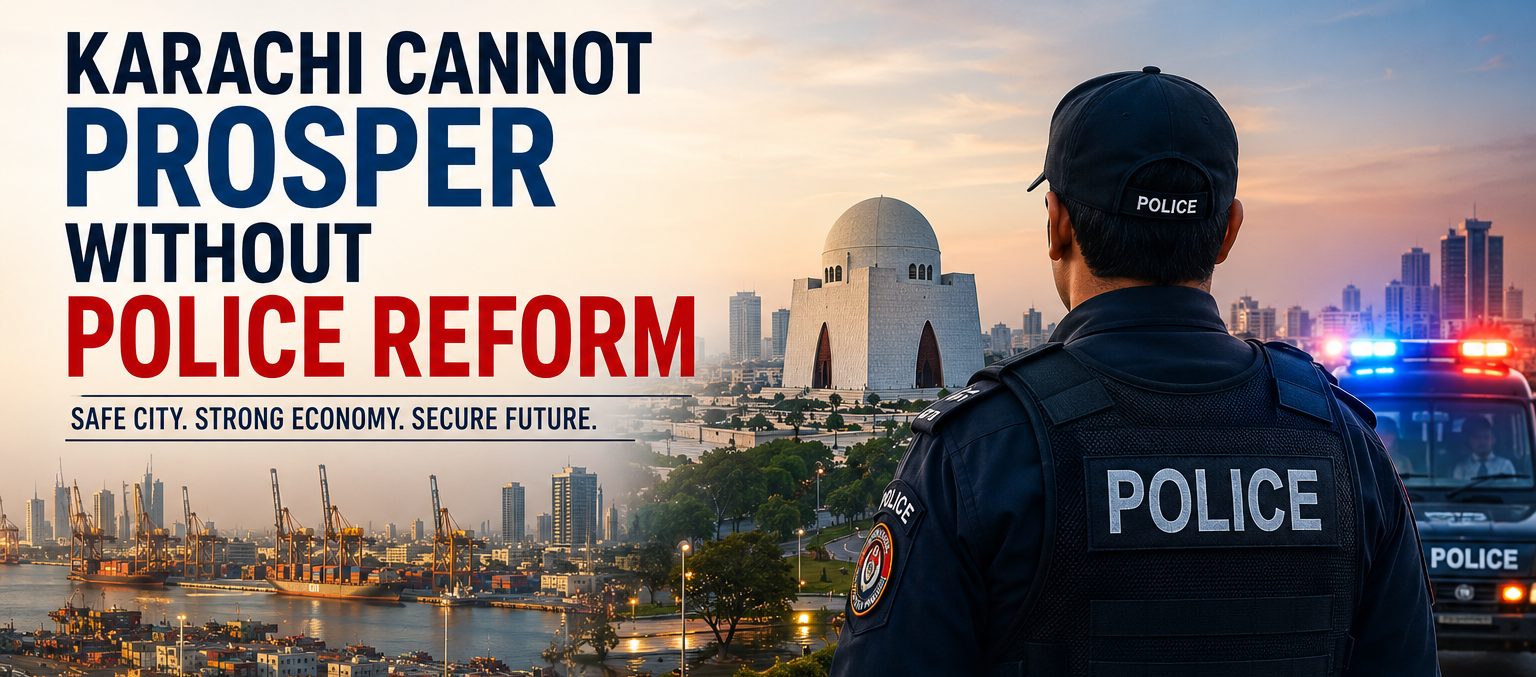
Karachi has long been regarded as Pakistan’s economic engine and one of South Asia’s most strategically important cities. Situated along the Arabian Sea and blessed with one of the region’s finest natural harbors, the city possesses immense commercial potential. It serves as Pakistan’s largest metropolitan center, home to millions of people from diverse cultural and ethnic backgrounds, and functions as the country’s principal financial and industrial hub. Despite these advantages, Karachi continues to struggle with persistent law-and-order challenges, political interference, weak governance, and declining public confidence in law enforcement. These issues have prevented the city from realizing its full economic potential.
A well-known saying states, “Where justice prevails, prosperity follows.” Karachi’s experience reflects this truth. While the city contributes nearly a quarter of Pakistan’s Gross Domestic Product (GDP), generates the largest share of federal tax revenues, and hosts the country’s major seaport, stock exchange, financial institutions, and industrial zones, its progress has repeatedly been undermined by insecurity. Thousands of people migrate to Karachi every year in search of better employment and economic opportunities, while refugees and migrants from neighboring countries further enrich its diversity but also add to the complexities of urban management.
Throughout history, the world’s most successful citiesincluding Singapore, Dubai, London, Tokyo, and Copenhagenhave demonstrated that sustainable economic growth depends upon strong institutions and the effective enforcement of the rule of law. Investors seek stable environments where contracts are honored, property is protected, and citizens enjoy personal security. Businesses flourish where justice is reliable and public institutions function efficiently.
Unfortunately, Karachi has spent decades confronting terrorism, political violence, sectarian conflict, organized crime, extortion, kidnappings, narcotics trafficking, land grabbing, cybercrime, and an alarming rise in street crime. These problems affect far more than individual victims. Companies invest heavily in private security, insurance premiums rise, investors hesitate, tourism suffers, and talented professionals often choose to relocate elsewhere. Crime not only causes financial losses but also damages public confidence and limits economic opportunities.
Although Karachi has one of the country’s largest concentrations of law-enforcement agencies, citizens ultimately judge policing through their personal experiences. Delays in registering complaints, prolonged investigations, and uncertainty in the justice system continue to weaken public trust. As the famous legal principle reminds us, “Justice delayed is justice denied.”
Pakistan’s policing structure still carries significant influence from the colonial-era Police Act of 1861, legislation originally designed to maintain imperial control rather than serve local communities. While Pakistan has evolved considerably since independence, elements of this command-oriented model remain embedded within the policing system. In a democratic society, however, citizens should be treated as partners in maintaining public safety rather than subjects to be controlled. Police officers must represent fairness, service, and justice instead of fear.
One of the most significant barriers to professional policing remains political interference. Effective law enforcement cannot thrive when transfers, promotions, or criminal investigations are influenced by political considerations. When merit gives way to favoritism, professionalism suffers, honest officers become demoralized, public confidence declines, and criminal networks exploit institutional weaknesses. Every police officer should remain accountable only to the Constitution and the law, free from political pressure or vested interests.
At the same time, calls for reform should never be interpreted as criticism of the entire police force. Thousands of courageous police officers have sacrificed their lives while combating terrorism, violent extremism, and organized crime. Many continue to perform demanding duties under dangerous conditions, with limited resources, long working hours, and significant psychological stress. These officers deserve respect, institutional support, and a system that rewards integrity, competence, and professionalism.
Modern policing requires much more than physical courage. Today’s criminal investigations increasingly depend upon forensic science, digital evidence, cyber intelligence, financial investigations, behavioral analysis, surveillance systems, artificial intelligence, and scientific crime-scene management. Countries that have successfully reduced crime have invested not only in stronger policing powers but also in technology, education, research, and specialized training.
Karachi now faces a defining choice. It can continue reacting to crime after incidents occur, or it can adopt comprehensive reforms that address the structural causes of insecurity. The future of the city will depend not on the number of police checkpoints but on the professionalism, efficiency, integrity, and public confidence enjoyed by its police service.
The first priority should be a transparent, merit-based recruitment process. Police officers must be selected through competitive examinations, educational qualifications, psychological assessments, and objective evaluation rather than political influence or personal recommendations. Merit-based recruitment promotes independence, professionalism, and accountability while reducing opportunities for corruption.
Training must also be modernized to prepare officers for twenty-first-century policing. Police personnel should receive specialized instruction in criminology, forensic science, cybercrime investigations, financial crimes, psychology, negotiation, conflict resolution, human rights, digital surveillance, artificial intelligence, and community policing. Criminal organizations increasingly rely on encrypted communication, digital banking, and transnational networks, making continuous professional development essential.
Technology should become an integral part of Karachi’s policing strategy. Police stations should function as digital command centers where complaints are filed electronically, investigations are monitored online, forensic services are readily available, and patrol officers are equipped with body-worn cameras and GPS-enabled systems. Artificial intelligence can help identify crime hotspots, analyze criminal trends, predict repeat offenses, and improve the deployment of police resources. Although technology cannot replace honesty and professionalism, it can significantly improve transparency, accountability, and operational efficiency.
Equally important is the welfare of police personnel. Society cannot expect exceptional commitment while neglecting the legitimate needs of those responsible for enforcing the law. Competitive salaries, modern housing, quality healthcare, psychological counseling, reasonable working hours, family welfare, and continuous professional education should be viewed as long-term investments rather than unnecessary expenditures. A financially secure and professionally motivated police force is more capable of delivering impartial and effective public service.
Police reform alone, however, cannot eliminate crime. Criminology consistently demonstrates that criminal behavior is often linked to unemployment, poverty, illiteracy, drug addiction, broken family structures, and social inequality. Every young person provided with quality education, vocational skills, or meaningful employment represents one fewer potential recruit for organized crime. As Victor Hugo wisely observed, “He who opens a school door closes a prison.” Crime prevention must therefore begin not only in police stations but also in classrooms, vocational training centers, sports facilities, and employment programs.
Citizen participation is another essential pillar of effective policing. Public safety cannot be achieved by law-enforcement agencies alone. Around the world, successful police organizations have embraced community policing, transforming residents into active partners in maintaining security. Neighborhood committees, digital reporting systems, anonymous witness protection mechanisms, youth engagement initiatives, and regular dialogue between police leadership and local communities can gradually rebuild the trust that has eroded over many years.
Civic education should also receive greater attention. Educational institutions should teach students about their constitutional rights, civic responsibilities, traffic discipline, ethical conduct, and the basic principles of criminal law. Practical handbooks explaining citizens’ rights, police procedures, and legal responsibilities should be published in Urdu and regional languages to improve public awareness and reduce misunderstandings.
Transparency and accountability must become permanent features of police governance. Honest officers deserve institutional protection, while those who abuse authority must face swift and impartial disciplinary action. Independent complaint commissions, judicial oversight, digital auditing systems, and publicly available performance indicators can strengthen the credibility and legitimacy of law enforcement.
The responsibility for reform does not rest solely with the police. Governments must resist political interference, legislators should modernize outdated laws, the judiciary must ensure timely justice, educational institutions should promote responsible citizenship, religious leaders should reinforce ethical values, and the media must report responsibly. Most importantly, citizens themselves must reject corruption in all its forms, because no society can expect integrity from its institutions while tolerating dishonesty in everyday life.
Karachi has repeatedly demonstrated extraordinary resilience. It has survived terrorism, political instability, economic crises, and natural disasters while continuing to drive Pakistan’s economy through the determination of its entrepreneurs, workers, and young people. What the city now requires is not another temporary security operation but a lasting transformation in governance and policing. Karachi deserves a police service that earns public respect through professionalism, inspires confidence through integrity, and measures success by preventing crime rather than merely responding to it.
If Pakistan genuinely wishes to unlock Karachi’s enormous economic potential, comprehensive police reform must become a national priority rather than a political slogan. A safer Karachi will attract greater domestic and foreign investment, create employment opportunities, reduce poverty, strengthen social harmony, and restore confidence in public institutions. The path to prosperity begins with justice, respect for the rule of law, and equal protection for every citizen regardless of wealth, status, or influence.
History teaches a timeless lesson: nations do not decline because criminals become powerful; they decline when honest citizens lose faith in justice. If Karachi succeeds in restoring that faith through meaningful police reform, it can once again emerge as Pakistan’s economic gateway and serve as a model for urban governance and sustainable development across the developing world.
The columnist is a Program Consultant in Islamic Banking and Applied Finance, teacher, trainer, author, banker, and broadcaster. He can be reached at:pride4pen@gmail.com.