



For Pakistan, the Real Test Is What This Investment Delivers
By Shahid Anwar
Pakistan is preparing for one of the largest investments in its oil-refining sector, with the planned modernization of five existing refineries expected to attract more than $6 billion. The scale of the proposed investment is significant, but the real test will not be the amount announced or the number of agreements signed. The real question is what Pakistan ultimately gets in return.
The government must ensure that this investment translates into higher domestic production of petrol and high-speed diesel, lower furnace oil output, greater refinery efficiency, reduced dependence on imported refined petroleum products and measurable foreign-exchange savings.
The five refineries covered by the programme are Pak-Arab Refinery Limited (PARCO), Pakistan Refinery Limited (PRL), National Refinery Limited (NRL), Cnergyico and Attock Refinery Limited (ARL).
Pakistan’s consolidated refining capacity remains around 450,000 barrels per day, equivalent to approximately 20.5 million tonnes annually. However, refineries have been operating below their installed capacity, highlighting a mismatch between existing refinery technology and the country’s changing petroleum demand.
Why Refinery Modernization Matters
The underutilization of Pakistan’s refining capacity is not simply a consequence of ageing plants. It is also a structural problem involving the types of petroleum products that refineries can efficiently produce.
Pakistan’s demand has increasingly shifted towards petrol and high-speed diesel, while demand for furnace oil has weakened, particularly as the power sector has moved towards alternative energy sources. Modernization is therefore essential to enable domestic refineries to produce a greater proportion of the fuels required by the economy.
The government’s latest initiative follows several years of policy discussions. The Oil Refining Policy was originally notified in 2023 and amended in 2024, but implementation encountered challenges related to taxation, regulation and the commercial viability of refinery investments.
In July 2026, the Council of Common Interests (CCI) approved further amendments, helping pave the way for implementation. The government has also been working to attract financing and investment, including through international roadshows.
Under the revised implementation framework, Inter State Gas Systems (ISGS) has been designated as the implementation agency. Its responsibilities include facilitating agreements with refineries, monitoring projects and administering the mechanism through which upgrade-related incentives will be provided. Independent technical verification is also intended to ensure that investment commitments translate into actual progress.
This distinction is critical.
Signing an agreement is only the beginning.
Refinery modernization is a technically complex and capital-intensive undertaking. Foreign financing, feasibility studies, front-end engineering and design, financial close, construction and commissioning can take considerable time. The government must therefore clearly distinguish between investment commitments and investment actually deployed.
A refinery should not be considered successfully upgraded merely because an agreement has been signed.
The Foreign-Exchange Argument
The economic case for modernization is strong. Pakistan remains heavily dependent on imported petroleum products. According to the Pakistan Economic Survey 2025-26, petroleum imports reached approximately 13.88 million tonnes during July-March FY2026, compared with 12.53 million tonnes during the corresponding period a year earlier. The petroleum import bill rose to approximately $8.9 billion.
These figures demonstrate why refinery modernization has important implications for Pakistan’s external sector.
Every additional litre of petrol or diesel produced efficiently within Pakistan has the potential to reduce the country’s import requirements. However, the actual foreign-exchange saving will depend on refinery output, international oil prices, domestic demand and other market conditions.
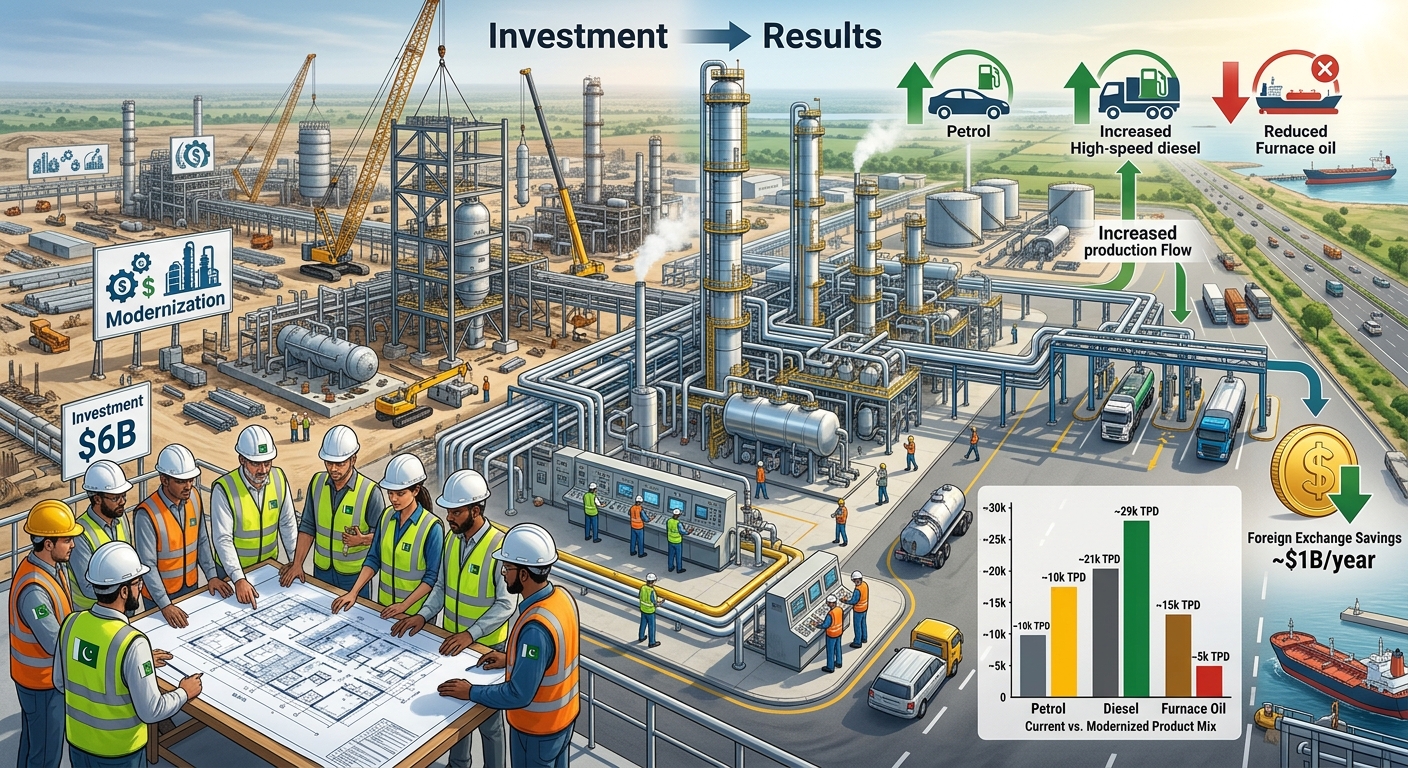
The government has estimated that upgraded refineries could eventually generate foreign-exchange savings of around $1 billion annually. This should be treated as a potential outcome rather than a guaranteed saving.
The critical issue is therefore to establish a mechanism through which the claimed savings can be measured objectively.
Changing the Product Mix
Perhaps the most important economic objective of the programme is to transform Pakistan’s refinery product mix.
Government projections indicate that petrol production could increase from approximately 10,700 tonnes per day to 18,400 tonnes, while high-speed diesel production could rise from around 21,240 tonnes to 29,520 tonnes per day.
At the same time, furnace oil production is projected to decline substantially, from approximately 15,417 tonnes to 5,714 tonnes per day.
This is precisely the kind of structural transformation Pakistan needs.
The country does not simply require more refining capacity. It requires modern refining capacity capable of producing the products that consumers and the economy actually need.
The latest demand figures reinforce this argument. Petroleum product consumption reached approximately 13.64 million tonnes during July-March FY2026, representing an increase of 3.5 percent over the same period a year earlier.
The transport sector accounted for approximately 82.5 percent of petroleum demand, demonstrating the continuing importance of petrol and diesel to Pakistan’s economic activity.
Environmental Benefits
There is also an important environmental dimension to the modernization programme.
The upgraded refineries are expected to move towards the production of Euro-V standard fuels. Higher-quality fuels can contribute to lower emissions and bring Pakistan’s domestic refining industry closer to modern international standards.
However, environmental benefits cannot be assumed merely because modernization has been announced. They will depend on actual implementation, compliance with product-quality standards and effective regulatory enforcement.
Incentives Must Be Linked to Performance
The government must carefully examine the cost of incentives being offered to refineries.
Public policy support can be justified when it generates broader economic benefits, including lower imports, improved energy security, employment, technological modernization and stronger domestic industrial capacity.
But incentives should not become an open-ended transfer to refinery owners without measurable economic returns.
This is why the implementation mechanism is so important.
Government incentives should be linked to clearly defined milestones, independently verified technical progress and measurable improvements in refinery output. Payments or benefits should follow verified investment and performance rather than simply the signing of agreements.
Such an approach would protect public resources while providing investors with a clear and predictable framework.
Measure What Matters
The government should establish a transparent set of performance indicators for the entire refinery modernization programme.
These indicators could include:
- Actual investment deployed
- Refinery utilization rates
- Additional petrol production
- Additional high-speed diesel production
- Reduction in furnace oil output
- Reduction in petroleum-product imports
- Foreign-exchange savings
- Progress towards Euro-V fuel production
- Improvements in refinery efficiency
These indicators would allow both the government and the public to determine whether the programme is delivering the promised economic benefits.
As an economic analyst, I believe these indicators should be at the core of the programme, rather than being treated as secondary reporting requirements.
The success of refinery modernization should ultimately be judged through measurable improvements in production, import substitution, efficiency and foreign-exchange savings.
A transparent monitoring system would also strengthen investor confidence by providing certainty about how incentives are connected to actual performance.
Looking Beyond Today’s Fuel Demand
There is another issue that deserves serious attention: Pakistan’s future fuel demand will not remain unchanged.
Electric vehicles, hybrid vehicles, improvements in fuel efficiency and changes in the electricity-generation mix could gradually alter the country’s demand for petroleum products.
Refinery investments must therefore be commercially and strategically viable over the long term rather than being based exclusively on today’s demand patterns.
This does not weaken the case for modernizing existing refineries. Pakistan will continue to require substantial quantities of liquid fuels for transport, agriculture, industry and other economic activities for many years.
The challenge is to ensure that domestic refineries are technologically capable of meeting this demand efficiently, competitively and sustainably.
From Investment Announcements to Economic Returns
From an economic-policy perspective, the government should shift its focus from announcing investment to measuring economic returns.
The $6 billion figure is impressive, but the size of the investment alone does not make the programme a success.
The real benefits will emerge only if modernization:
- Increases efficient domestic production of petrol and diesel;
- Reduces dependence on imported refined petroleum products;
- Cuts furnace oil production in line with domestic demand;
- Improves refinery efficiency and economics; and
- Strengthens Pakistan’s energy security and balance of payments.
Three outcomes should therefore be treated as essential benchmarks.
First, petrol and high-speed diesel production should increase sufficiently to reduce import dependence.
Second, furnace oil production should decline to a level consistent with actual domestic demand.
Third, government incentives should remain firmly linked to independently verified investment and performance.
Strengthening Energy Security
Pakistan has an opportunity to modernize an important part of its industrial and energy infrastructure. However, this opportunity must be approached with financial discipline and a clear focus on measurable economic outcomes.
The government must ensure that the refinery programme does not become merely another investment announcement. It should result in a measurable improvement in Pakistan’s energy security, industrial efficiency and balance of payments.
The current geopolitical environment makes this objective even more important. Pakistan remains exposed to international oil prices, shipping disruptions and interruptions in global energy supply chains.
Recent efforts to strengthen strategic petroleum reserves and fuel-supply resilience underline the importance of reducing vulnerability to external shocks. Modernizing domestic refining capacity can form an important part of this broader energy-security strategy.
Ultimately, the real measure of success will not be the size of the investment announced, but the economic results it delivers for Pakistan.
Shahid Anwar is an Economic Analyst and Business & Trade Advisor, and former Secretary General of the Federation of Pakistan Chambers of Commerce & Industry (FPCCI). He also served as Senior Director Research at the Institute of Cost and Management Accountants of Pakistan (ICMAP), with 36 years of experience in economic, business and trade affairs. He provides advisory support on trade, investment and business partnerships. He can be reached at shahid.anwar.writer.26@gmail.com
Disclaimer: This article is intended for general information, public discussion and economic analysis only. It does not constitute financial, investment, legal or professional advice. Readers are encouraged to independently verify relevant information and consult appropriate professionals before making business, investment or policy decisions. This image is AI-generated and is used for illustrative purposes only.