

By Shahid Anwar
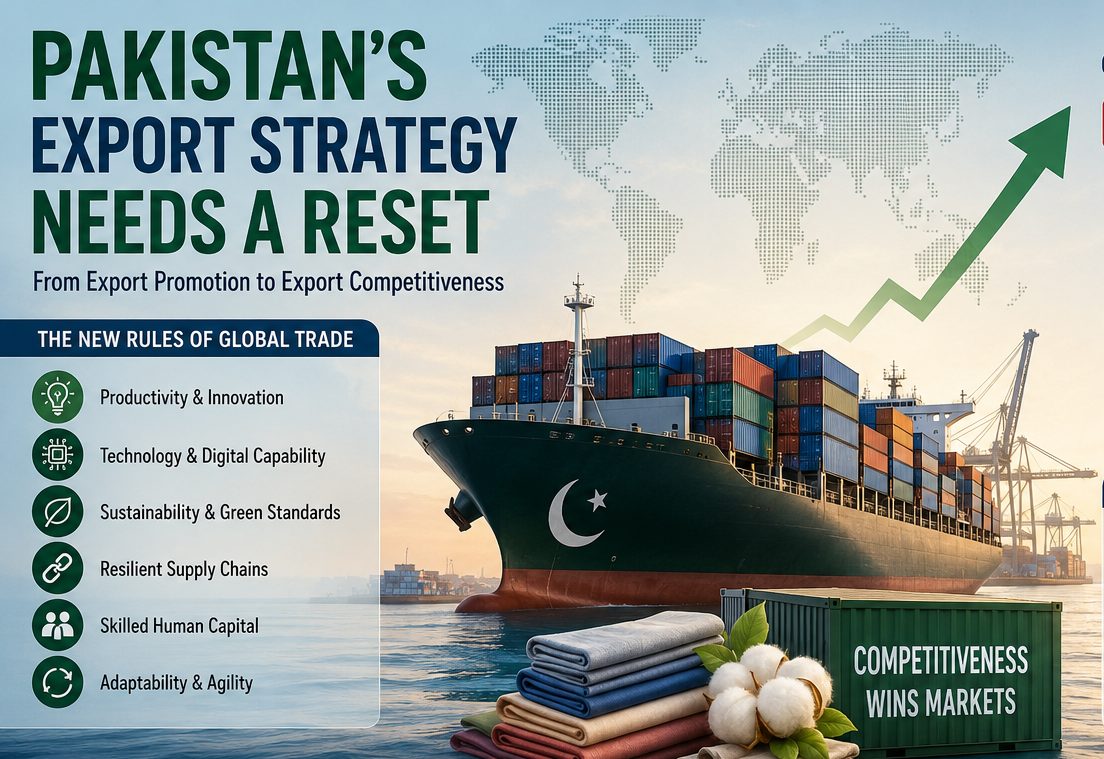
For decades, Pakistan’s export strategy has focused primarily on expanding exports through market access, preferential trade agreements, and export promotion initiatives. While these remain essential, the dynamics of global trade have changed dramatically. Today, international competitiveness is driven less by market access alone and more by productivity, innovation, technology, sustainability, digital capabilities, resilient supply chains, and the ability to adapt quickly to changing market conditions.
Against this backdrop, the Ministry of Commerce deserves recognition for keeping export promotion high on the national agenda despite difficult economic circumstances. Through trade diplomacy, preferential trade agreements, market access initiatives, the support of the Trade Development Authority of Pakistan (TDAP), and continuous engagement with the business community, the Ministry has created new opportunities for Pakistani exporters. These efforts are vital because expanding exports remains fundamental to economic growth, foreign exchange earnings, and employment generation.
Pakistan’s merchandise exports reached approximately US$ 32.4 billion in 2024, while information technology exports have continued their encouraging upward trajectory, reflecting the resilience and potential of Pakistani businesses. However, export performance should not be measured solely by total export earnings. The more important question is whether Pakistan is increasing its share of global markets and strengthening its competitive position relative to its international rivals.
For years, the national debate has centered on a single question: How can Pakistan export more? While this remains an important objective, an even more strategic question deserves attention: Is Pakistan becoming more competitive than its competitors?
In today’s rapidly evolving global trading environment, increasing export volumes is important, but retaining and expanding market share is even more critical. Export promotion may help secure orders, but export competitiveness is what secures long-term markets.
Short-term fluctuations in exports are inevitable. Sustainable success depends on productivity growth, innovation, technological advancement, efficient logistics, skilled human capital, and the ability to respond rapidly to changing market demands.
The rules of global trade are being rewritten. Competitiveness is no longer determined solely by price and quality. Artificial intelligence, advanced manufacturing, digital trade, sustainability standards, carbon regulations, supply chain resilience, and evolving buyer expectations are becoming decisive factors in determining which countries gainor losemarket share.
These are not future challenges; they are already influencing purchasing decisions, investment flows, and global supply chains. Countries that recognized these changes early have repositioned their industries successfully, while others risk losing competitiveness despite enjoying traditional market access.
Pakistan’s export base remains heavily concentrated in traditional sectors, particularly textiles and apparel. These industries will continue to form the backbone of the country’s exports, but the competitive landscape has changed fundamentally. International buyers now evaluate suppliers not only on cost and quality but also on productivity, innovation, digital capabilities, sustainability, and compliance with international standards.
The experience of competing economies offers valuable lessons.
Vietnam has successfully combined an extensive network of free trade agreements with sustained investment in manufacturing capability, logistics, technology, and integration into global value chains. As a result, its merchandise exports now exceed US$ 400 billion annually, compared with Pakistan’s approximately US$ 32 billion.
Malaysia has steadily strengthened its position in high-value manufacturing through electronics, semiconductors, and digital industries. Bangladesh has complemented its apparel sector with significant investments in green manufacturing, regulatory compliance, and export readiness. Meanwhile, the UAE has transformed itself into a leading global trade and logistics hub through world-class infrastructure, digital trade facilitation, and business-friendly policies.
The apparel industry clearly demonstrates the changing nature of global competition. Pakistan possesses a strong textile base and decades of manufacturing expertise. Yet Bangladesh has become the world’s second-largest apparel exporter after China, while Vietnam has significantly expanded its position within global manufacturing value chains. Their success is not based solely on lower production costs but on sustained investment in productivity, technology, logistics, regulatory compliance, and industrial competitiveness.
The European Union’s Carbon Border Adjustment Mechanism (CBAM) provides another clear example of how global trade rules are evolving. Exporters in carbon-intensive industries will increasingly need to demonstrate the carbon footprint of their products. For Pakistan’s textile sectorwhich accounts for roughly 60 percent of merchandise exportsthis is no longer a distant regulatory issue. It is becoming an increasingly important determinant of future market access.
Digital trade presents both an opportunity and a challenge. Countries such as Vietnam and India have invested heavily in cross-border e-commerce, digital payment systems, logistics infrastructure, and government-supported digital trade facilitation. These investments have enabled their businesses to reach global consumers more efficiently, while many Pakistani exporters continue to operate with limited institutional support in this rapidly expanding space.
Similarly, the restructuring of global supply chains under the “China Plus One” strategy has created significant opportunities for emerging manufacturing economies. Vietnam acted swiftly to attract relocating industries, while Bangladesh further strengthened its apparel manufacturing base.
Pakistan, however, has yet to develop a comprehensive strategy to position itself as a preferred destination for supply chain relocation by identifying priority sectors, improving investment facilitation, and effectively promoting its manufacturing capabilities to global investors.
These examples highlight an important reality: successful exporting nations are no longer focused merely on selling more products abroad. They are building the capabilities needed to compete in tomorrow’s markets. This is the strategic shift that Pakistan’s trade policy must now embrace.
Although considerable attention is devoted to export promotion, comparatively less emphasis is placed on export competitiveness intelligence. Most existing initiatives focus on helping Pakistan sell more of what it already produces in markets it already serves. The greater challenge is preparing Pakistani industries for markets where the very conditions of entry are rapidly changing.
Pakistan must understand not only what it exports but also which products are gaining or losing global market share, which competitors are outperforming Pakistan, why international buyers are shifting toward alternative suppliers, and which emerging industries present future export opportunities.
The Ministry of Commerce should build upon its existing role by evolving into Pakistan’s strategic trade intelligence institution. Leading commerce ministries across the world increasingly function as centers of intelligence and foresight, continuously monitoring regulatory developments, technological change, buyer preferences, and competitive shifts while translating this knowledge into practical guidance for domestic industries.
Trade policy can no longer remain reactive. It must become forward-looking, enabling policymakers and businesses to identify emerging risks and opportunities before they reshape international markets.
No exporter should first learn about a major international compliance requirement from a foreign buyer after an order has already been placed. Public institutions should provide such intelligence well in advance, enabling businesses to prepare proactively before new standards become barriers to trade.
One practical initiative would be for the Ministry of Commerce, in collaboration with TDAP, to publish a Quarterly Pakistan Export Competitiveness Report. Rather than serving merely as a statistical publication, it should function as a strategic early-warning system by monitoring Pakistan’s global market share, benchmarking competing economies, identifying emerging regulations, assessing technological developments, and highlighting future export opportunities. Such a report would strengthen evidence-based policymaking and enable exporters to respond proactively rather than react after markets have already shifted.
Export competitiveness extends beyond the mandate of any single institution. It requires close coordination among the Ministries of Commerce, Industries and Production, Information Technology, and Climate Change, along with TDAP, SMEDA, research institutions, chambers of commerce, and the private sector. In today’s interconnected economy, competitiveness has become a national agenda rather than the responsibility of one ministry alone.
Pakistan possesses significant strengths: an entrepreneurial private sector, internationally recognized textile and agricultural products, a rapidly expanding IT sector, a young workforce, and a strategic geographic location linking South Asia, Central Asia, China, and the Middle East. These advantages provide a strong foundation for future growth.
The challenge is to complement these strengths with higher productivity, greater innovation, wider technology adoption, stronger skills development, and improved institutional preparedness. Future export competitiveness will also depend on developing a workforce equipped with advanced manufacturing, digital, and emerging technology skills.
The next generation of export success will not be determined simply by how many markets Pakistan enters, but by how competitive its industries remain after entering those markets. The countries leading global trade today are not necessarily those with the lowest costs; they are those that anticipate change, invest in capabilities, and continuously enhance their competitiveness.
Pakistan has the entrepreneurial talent, industrial foundation, and strategic location needed to compete globally. What is now required is a modern trade policy that places productivity, innovation, technology adoption, and market intelligence at the heart of its export strategy.
The future challenge is not merely to export moreit is to ensure that Pakistani products remain the preferred choice of global buyers in an increasingly demanding marketplace.
The next chapter of Pakistan’s trade policy should therefore move beyond an Export Promotion Strategy toward a comprehensive Export Competitiveness Strategy. The nations that prepare today for tomorrow’s trading environment will shape the future of global commerce. Pakistan must ensure that it is among them.