
By Yousuf Ibnul Hasan
Karachi’s transformation from a modest coastal settlement into Pakistan’s financial and commercial capital was not the achievement of a single community. Its remarkable development was shaped by people of different faiths, cultures and backgrounds whose enterprise, philanthropy and civic commitment helped build the citys economic, educational and social foundations.
Historically, Karachi developed as a cosmopolitan trading centre where Muslims, Hindus, Parsis, Christians, Sikhs, Jews, Bahais, Armenians, Goans, Memons, Bohras, Khojas and other communities contributed to commerce, education, healthcare, industry and civic life. Historical accounts also document Karachi’s diverse population and its emergence as a major port and commercial centre during the 19th century.
Karachi’s Rise as a Cosmopolitan City
Karachi’s natural harbour gave the city enormous strategic importance. As maritime trade expanded, merchants and professionals from different parts of South Asia and beyond settled here, bringing capital, commercial knowledge and entrepreneurial experience.
The resulting diversity helped establish Karachi as a major centre of trade and industry. By the late 19th century, the city had developed modern transportation, public buildings and commercial infrastructure, while its population included Muslims, Hindus, Zoroastrians, Christians, Jews and people of several linguistic and cultural backgrounds.
The city’s history therefore represents a story of cooperation and shared enterprise rather than the achievement of one group alone.
The Parsi Community’s Extraordinary Contribution
Among Karachi’s minority communities, the Parsis occupy a particularly important place in the citys economic and civic history.
Although relatively small in number, Parsi entrepreneurs became prominent in shipping, commerce, engineering, banking and other areas of economic activity. Historical research records the rapid establishment of Parsi community institutions in Karachi, including schools, housing projects, charitable dispensaries, a maternity hospital and social institutions. Parsi entrepreneurs also played roles in the development of the port, tramway network and organised commerce.
Education and philanthropy became particularly important elements of the Parsi legacy. Institutions associated with Parsi philanthropy include BVS Parsi High School and Mama Parsi Girls Secondary School, while Parsi benefactors also supported healthcare, housing and other public-oriented initiatives.
Their legacy demonstrates how private enterprise, when combined with social responsibility, can have a lasting impact on an entire city.
Hindu Merchants and Karachi’s Commercial Growth
The Hindu community also played a major role in Karachi’s commercial development before Partition. Hindu merchants and business families were deeply involved in trade, finance, shipping, textiles and wholesale commerce.
Historic areas such as Kharadar, Mithadar and Boulton Market developed as important commercial centres, reflecting the activity of merchants and trading communities that connected Karachi with markets across the region and overseas.
Hindu philanthropists also contributed to education, healthcare and charitable activities. Their commercial networks helped strengthen Karachi’s position as an important trading centre before the creation of Pakistan.
The demographic transformation that followed Partition profoundly changed the composition of Karachi. Nevertheless, the city’s pre-Partition commercial and architectural heritage continues to reflect the contributions of communities that helped develop it.
Christian Community’s Contribution to Education and Healthcare
The Christian community’s contribution to Karachi is particularly visible in education, healthcare, nursing and social welfare.
Christian institutions established schools, colleges, hospitals and nursing facilities that served people from different religious and social backgrounds. Schools such as St. Patrick’s High School and St. Joseph’s Convent School became important educational institutions, producing generations of professionals and public figures.
A recent academic study of Karachi’s urban history likewise highlights the Christian community’s longstanding involvement in education, healthcare, municipal services and construction, arguing that these contributions have often received insufficient attention in accounts of the citys development.
The contribution of Christian institutions illustrates how education and healthcare can become lasting forms of civic service.
Sikhs, Jews, Armenians, Goans and Other Communities
Karachi’s pluralistic character was also enriched by smaller communities.
Sikh entrepreneurs and professionals participated in commerce, transport, engineering, construction and other sectors. Jewish, Armenian and Goan communities contributed through trade, professional services, culture and civic participation.
The city’s historical diversity was not simply demographic. It influenced its architecture, commercial culture, education, social institutions and public life.
Historic Karachi still carries evidence of this multicultural past through its schools, religious buildings, markets, civic structures and neighbourhoods.
Philanthropy: A Legacy Beyond Business
Perhaps the most important legacy of Karachi’s minority communities was their culture of philanthropy.
Parsi philanthropists established and supported schools, hospitals, maternity facilities, housing schemes, libraries, parks and charitable institutions. Christian organisations contributed to welfare programmes and care for vulnerable people, while Hindu philanthropists supported educational, healthcare and community initiatives.
This tradition reflected a broader principle: economic success carries a responsibility toward society.
Karachi’s historic landmarks, including Frere Hall, Empress Market, Merewether Tower and numerous religious and educational institutions, remain reminders of an era when private philanthropy and civic development were closely connected.
Preserving Karachi’s Shared Heritage
Karachi today faces major challenges, including rapid urbanisation, infrastructure pressures, environmental degradation and the deterioration of historic sites. In this environment, the city’s multicultural heritage deserves renewed attention.
Preserving historic buildings is not merely about protecting old architecture. It is also about remembering the people, communities and values that shaped Karachi.
The city’s heritage demonstrates that its development was a collective process. Muslims and minority communities contributed to its ports, markets, businesses, schools, hospitals, charitable organisations and civic institutions.
Diversity as Karachi’s Greatest Strength
Karachi’s history offers an important lesson for the future: diversity can be a source of economic, cultural and social strength.
The city prospered when people from different backgrounds participated in its development, exchanged ideas and invested in institutions that served society as a whole. Contemporary Karachi can draw upon that history by promoting tolerance, merit, enterprise, civic responsibility and respect for its diverse heritage.
The contributions of minority communities are therefore not merely a chapter in Karachi’s past. They are woven into the city’s streets, markets, schools, hospitals, landmarks and institutions.
Karachi was built by many hands, and its future can likewise be strengthened when all communities are recognised as stakeholders in its development.
The true wealth of Karachi has never been measured only by its buildings or skyline. It is reflected in the vision of its entrepreneurs, the generosity of its philanthropists, the dedication of its educators and healthcare workers, and the countless citizens who contributed to the city’s progress.
Remembering this shared legacy is not simply an act of historical recognition. It is a reminder that Karachi’s greatest strength has always been its people, and the diversity, enterprise and civic spirit they brought to the city.
The columnist is a Program Consultant in Islamic Banking and Applied Finance, teacher, trainer, author, banker and broadcaster. He can be reached atpride4pen@gmail.com.
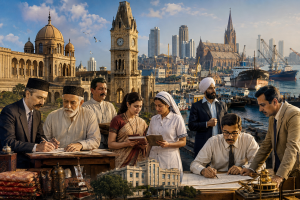
Disclaimer: Historical details and interpretations are presented in the context of the source material; readers should consult archival and academic sources for independent verification of specific historical claims. The image is AI-generated and is intended for illustrative purposes only.