



By Yousuf Ibnul Hasan
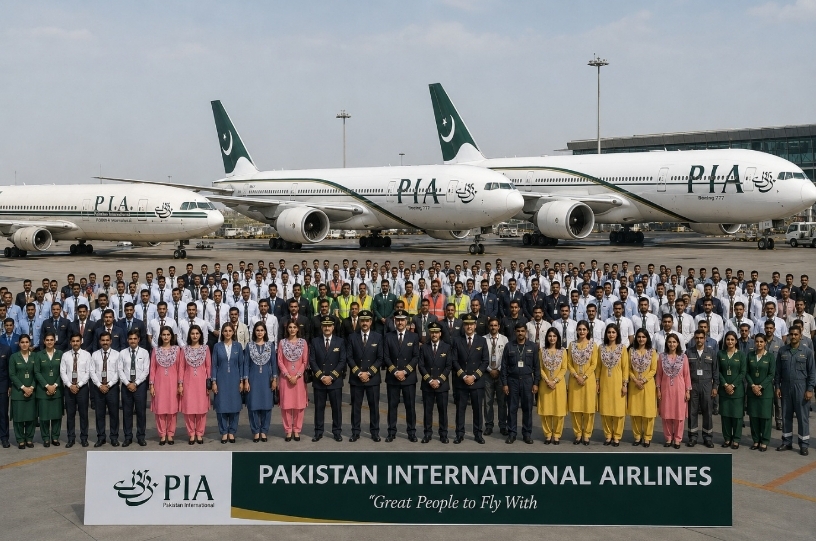
There are institutions that serve a nation, and there are institutions that define it. They become part of its history, embody its aspirations, and reflect its identity before the world. Pakistan International Airlines (PIA) is one such institution. More than a national carrier, it has long been a symbol of Pakistan’s confidence, hospitality, and global presence. Its remarkable journeyfrom visionary beginnings and international acclaim to years of decline and the promise of renewalmirrors the story of Pakistan itself.
The foundation of Pakistan’s national airline was laid even before the country came into existence. In June 1946, Quaid-e-Azam Muhammad Ali Jinnah, recognising that aviation would be indispensable to a modern state, entrusted the distinguished industrialist Mirza Ahmad Ispahani with the task of establishing a national airline. Acting on this vision, Orient Airways was created, bringing together highly skilled pilots, engineers, and aviation professionals while laying the foundations of an engineering and maintenance system that would later become the backbone of Pakistan’s civil aviation sector.
Following independence, the Government of Pakistan nationalised Orient Airways in 1955 and transformed it into Pakistan International Airlines. Its aircraft, infrastructure, and professional expertise became the cornerstone of the country’s national flag carrier. Mirza Ahmad Ispahani’s selfless contribution remains a shining chapter in Pakistan’s aviation history. Having fulfilled his national duty, he relinquished leadership without seeking personal gain, demonstrating a rare example of patriotism and public service.
During the 1960s, PIA earned worldwide recognition as one of the finest airlines in the world. Renowned for safety, punctuality, technical excellence, and gracious hospitality, it became Pakistan’s flying ambassador. At a time when many newly independent nations were still building their aviation industries, PIA was setting benchmarks that others sought to emulate. It trained aviation professionals, provided technical expertise, and assisted several emerging airlines across Asia and the Middle East, proving that Pakistan could compete with the best on the global stage. It was, without doubt, the jewel in the nation’s crown.
For millions of overseas Pakistanis, however, PIA represented something even more profound. A journey aboard the national carrier was not merely air travel; it was the first step towards home. From London to Dubai, Toronto to Kuala Lumpur, passengers found comfort in familiar language, warm hospitality, and the reassuring sight of Pakistan’s Green Crescent flying proudly across the skies. Few airlines have enjoyed such an enduring emotional bond with their people.
Karachi, The Gateway to the World: The extraordinary success of Pakistan International Airlines was inseparable from the strategic importance of Karachi. Long before Dubai, Doha, and Abu Dhabi emerged as global aviation hubs, Jinnah International Airport occupied one of the world’s most advantageous locations. Situated at the crossroads of Europe, the Middle East, Africa, and the Far East, Karachi naturally became a bridge between continents. International airlines relied on its facilities for refuelling, technical maintenance, cargo handling, and transit operations, while PIA’s engineering expertise and highly trained workforce earned widespread international respect. In those years, Karachi was not merely Pakistan’s principal airport; it was one of Asia’s most important gateways to the world.
This strategic advantage generated far-reaching economic benefits. Aviation brought foreign exchange, stimulated commerce, supported tourism, and created thousands of skilled jobs. PIA became more than a national carrier; it evolved into an engine of economic growth and a symbol of Pakistan’s growing confidence on the international stage. The airline demonstrated that professional management, technical excellence, and visionary leadership could elevate a young nation into the front ranks of global aviation.
Yet, as history repeatedly reminds us, success is never self-sustaining. Great institutions flourish through sound governance but decline when complacency replaces competence. PIA’s difficulties did not arise overnight; they accumulated over decades through inconsistent policies, political interference, financial indiscipline, and administrative weaknesses. Gradually, operational efficiency declined, commercial competitiveness weakened, and public confidence began to erode. The warning signs were visible long before the crisis reached its peak, but corrective action came too late. As the old saying goes, the writing was on the wall.
The pilots’ licence controversy proved to be the most damaging setback in the airline’s recent history. The suspension of PIA’s operations by European and British aviation authorities deprived millions of overseas Pakistanis of direct access to their national carrier. Journeys that had once been simple and convenient became longer, more expensive, and considerably more exhausting. Families faced unnecessary hardship, while business travellers lost valuable time and opportunities.
The consequences extended far beyond passenger inconvenience. Nature abhors a vacuum, and international aviation is no exception. As PIA withdrew from several profitable international routes, foreign airlines quickly occupied the space. Revenue that could have strengthened Pakistan’s economy instead flowed abroad, while the country lost valuable opportunities in tourism, trade, cargo operations, and aviation services. The decline of PIA was therefore not merely the story of an airline; it reflected a broader economic loss for Pakistan.
Despite these setbacks, the fundamentals that once made PIA successful have not disappeared. Pakistan’s geographical location remains unchanged, Karachi still occupies a strategic position between major global markets, and the emotional bond between the national carrier and millions of Pakistanis around the world remains remarkably resilient. History has presented PIA with another opportunity. Whether it can transform that opportunity into lasting success will depend not on sentiment alone but on vision, professionalism, and the courage to undertake meaningful reform.
A Second Chance to Soar: Today, Pakistan International Airlines stands at a defining moment in its history. As international restrictions ease and new opportunities emerge, the airline has been given a rare second chance. Yet history teaches us that opportunities favour those who are prepared to seize them. Nostalgia alone cannot restore a great institution; only vision, professionalism, and decisive leadership can.
The future of PIA will depend not merely on who owns it but on how it is governed. Around the world, successful airlines differ in ownership structures, but they all share the same foundations: professional management, financial discipline, operational excellence, technological innovation, uncompromising safety standards, and an unwavering commitment to customer satisfaction. PIA must adopt these principles not as aspirations but as its operating philosophy.
The airline also possesses advantages that many competitors can only envy. Pakistan’s strategic location places it at the crossroads of South Asia, Central Asia, the Middle East, and beyond, offering immense potential for passenger transit, air cargo, aircraft maintenance, engineering services, and aviation logistics. With a modern fleet, digital transformation, transparent governance, and commercially sound route planning, PIA can once again become an important contributor to Pakistan’s economy, generating employment, promoting tourism, supporting exports, and attracting foreign investment.
No revival strategy, however, can succeed without recognising the indispensable role of overseas Pakistanis. Spread across every continent, they are more than loyal passengers; they are among the airline’s greatest stakeholders. For decades, they have contributed significantly to Pakistan’s economy through their remittances while preserving an enduring emotional bond with their homeland. For many of them, boarding a PIA aircraft has never been simply the beginning of a journeyit has been the first embrace of home. That emotional connection is an invaluable asset which no balance sheet can quantify and no competitor can replicate.
Winning back their confidence should therefore be one of PIA’s foremost priorities. Passengers today expect more than transportation; they expect reliability, punctuality, safety, efficiency, competitive fares, and courteous service. Every successful flight strengthens confidence in the airline, while every disappointment undermines years of goodwill. In today’s aviation industry, actions speak louder than words, and sustained excellence is the only path to lasting credibility.
The responsibility for PIA’s revival does not rest solely with its management. Policymakers, aviation professionals, employees, investors, and the public all have a stake in its success. A national airline is more than a commercial enterprise; it is a visible expression of a nation’s confidence, competence, and identity. Every aircraft carrying Pakistan’s flag represents the country before the world, making professionalism and integrity not merely business objectives but national responsibilities.
History reminds us that great institutions are not remembered only for their achievements but for their ability to rise after adversity. PIA has overcome formidable challenges before, and there is every reason to believe it can do so again. The talent exists, the strategic location remains unchanged, and the goodwill of millions of Pakistanis at home and abroad endures. What is required is the collective resolve to transform potential into performance.
Pakistan International Airlines is far more than an airline. It is a bridge connecting millions of Pakistanis with their homeland, a symbol of national pride, and an ambassador of the Green Crescent in the skies. Its revival is therefore not merely a commercial objective but a national imperative. If guided by integrity, merit, innovation, and visionary leadership, PIA can once again reclaim its rightful place among the world’s respected airlines.
When a PIA aircraft rises above the clouds, it carries far more than passengers and cargo. It carries the hopes of a nation, the confidence of its people, and the honour of Pakistan. May Almighty Allah bless Pakistan International Airlines with wisdom in leadership, excellence in service, and enduring prosperity, enabling it once again to fly high as a proud ambassador of Pakistan before the world. The columnist served in Pakistan International Airlines’ Customer Services and Traffic Planning Departments in Lahore and Karachi from March 1977 to October 1982.
The writer is a Program Consultant in Islamic Banking and Applied Finance, teacher, trainer, author, banker, and broadcaster. He can be reached at: pride4pen@gmail.com