




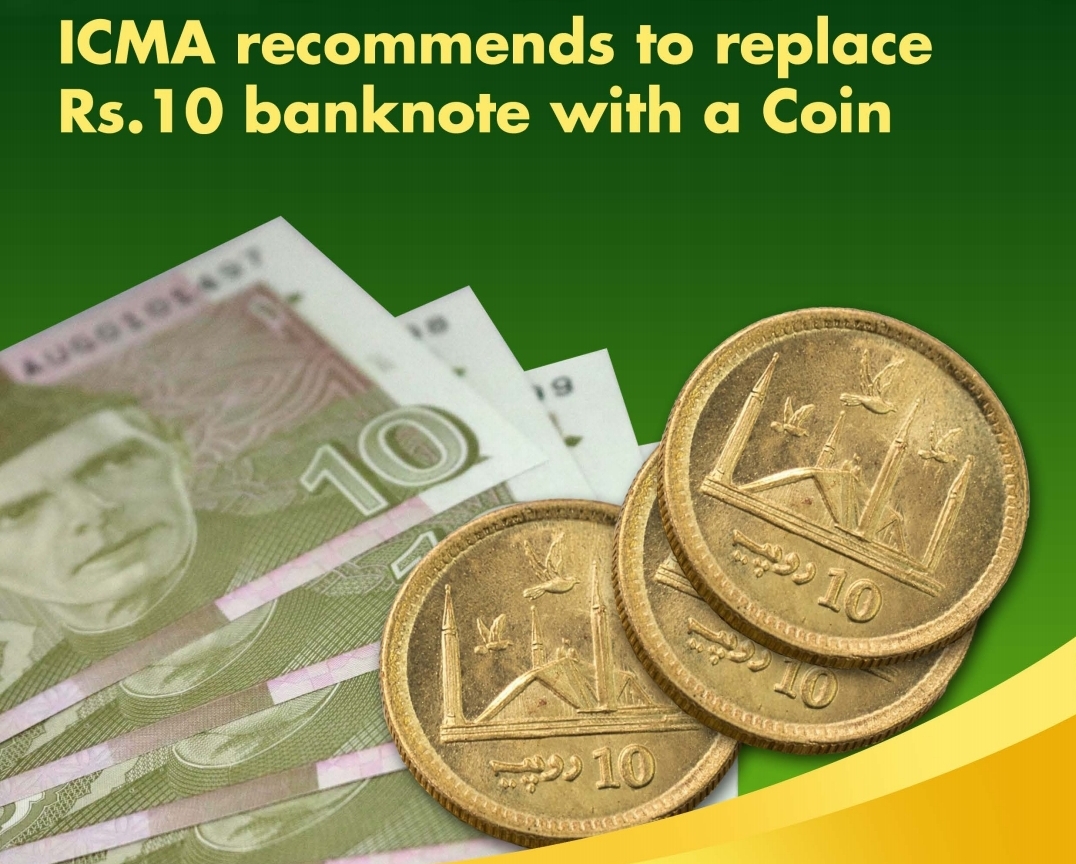
ICMA Pakistan has recommended replacing the Rs 10 banknote with a coin, arguing that the shift could save billions of rupees and improve currency management across Pakistan. The proposal comes after the federal cabinet constituted a high-level committee under the finance minister to review the sustainability of the Rs 10 note and examine more durable alternatives.
The Rs 10 note is among the most widely used denominations in everyday transactions, from tea stalls and buses to grocery stores and local markets. Yet its heavy usage means it wears out rapidly, surviving only six to nine months on average. Frequent reprinting and replacement lead to annual costs estimated at Rs 810 billion.
According to the State Bank of Pakistan Annual Report 202223, the denomination represents more than one-third of all banknotes printed but accounts for only about 1.2 percent of the total value of currency in circulation. Analysts say this imbalance strains printing capacity, raises operational expenses, and increases the environmental burden caused by repeated production.
ICMAs review highlights that the Rs 10 coin, first introduced in 2016, presents a practical alternative. Coins typically last 20 to 30 years, enjoy wide public acceptance, and are compatible with automated systems such as vending machines and transport fare mechanisms. Using figures from the State Bank and the Pakistan Mint, ICMA estimates that shifting to coins could generate savings of Rs 4050 billion over the coming decade, effectively converting a recurring cost into a long-term national asset.
International precedents suggest the transition can be smooth. The United Kingdom replaced its 1 note with a coin in 1983, Canada withdrew its $1 note in 1987 and $2 note in 1996, while Australia carried out similar changes during the 1980s. In each case, authorities reported improved efficiency and lower long-term costs.
Under the proposal, the changeover would be completed in three years. In the first year, printing of fresh Rs 10 notes would cease while coin production rises. The second year would prioritize public awareness and retailer readiness, and by the third year, remaining notes would naturally leave circulation through the banking system. Transition expenses, including mint upgrades and communication drives, are projected at Rs 3.5 billion and are expected to be recovered within roughly 18 months through savings.
ICMA maintains that the move represents more than financial prudence. It says the reform would streamline daily transactions, lower environmental impact, and provide citizens with a durable and reliable form of currency suited to modern needs.






KIndly send your profile. Thanks
[…] Also read: Karwan-e-Hayat Hosts Delegation from Pakistan Institute of Living and Learning and Univer… […]
[…] Korangi Police Arrest Two Key Suspects in Rs. 9.7 Million Cash Van Robbery within 24 Hours […]