

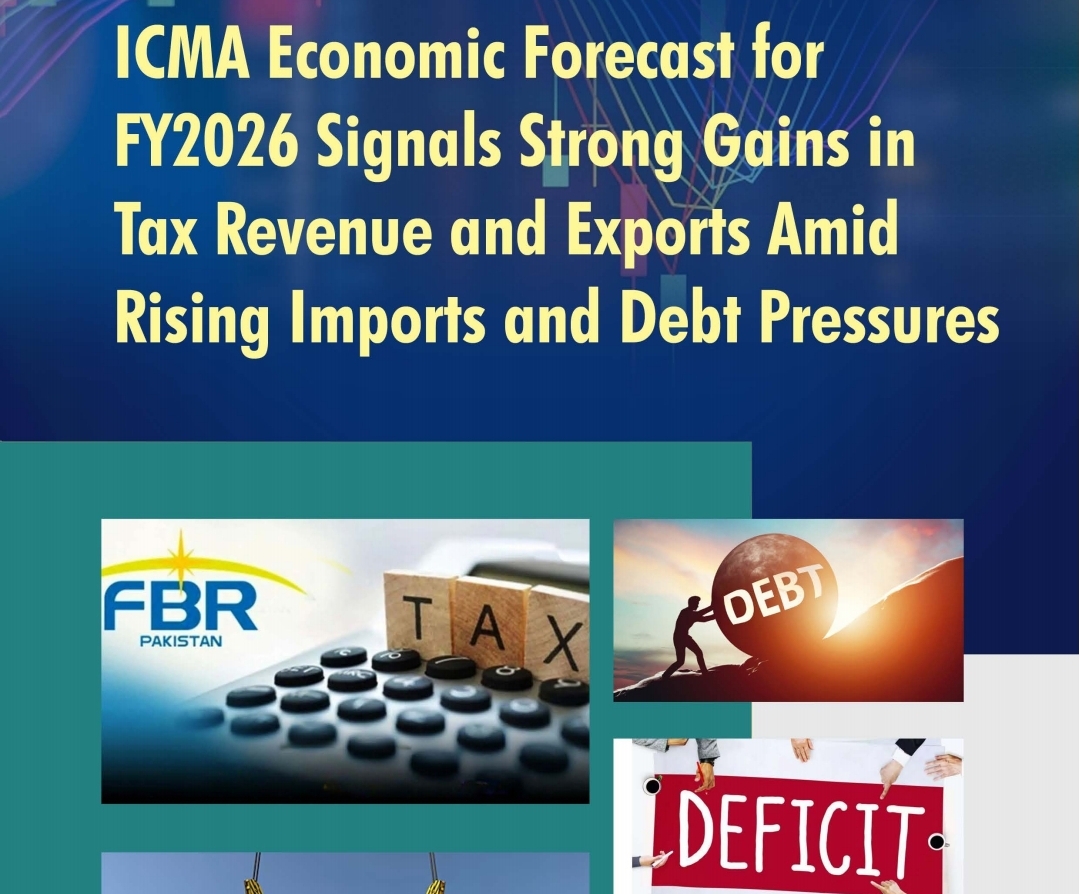
The Institute of Cost and Management Accountants of Pakistan (ICMA) has released its economic forecast for FY2026, projecting continued improvement in exports and tax revenues while cautioning that rising imports and domestic debt will remain major policy challenges.
The projections, prepared by ICMAs Research and Publications Department, are based on actual outcomes of FY24 and FY25 along with early indicators from FY26. The institute describes the assessment as independent and evidence-based, while noting that future results may change due to unforeseen developments, policy shifts, or external shocks.
FY25 Performance Shows Resilience
According to the report, Pakistan demonstrated resilience during FY25, creating a base for further recovery. Federal Board of Revenue (FBR) tax collection rose significantly to Rs. 12,722.9 billion, compared to Rs. 10,085.2 billion in FY24.
Exports reached $32 billion, while imports stood at $60.3 billion, resulting in a trade deficit of $28.19 billion. However, the current account posted a $2.1 billion surplus, supported by stronger exports and relatively contained import growth.
Other key indicators also showed improvement. The average policy rate declined to 16% from 22% a year earlier, inflation eased to 4.5%, real GDP grew by 3%, and net foreign direct investment (FDI) stood at $2.5 billion.
At the same time, debt levels remained high. Domestic debt climbed to Rs. 54,471.5 billion, central government debt reached Rs. 77,888.4 billion, and total debt and liabilities increased to Rs. 94,197.1 billion. The federal budget deficit narrowed to Rs. 7,444 billion.
FY26 Outlook: Faster Growth, Persistent Risks
For FY26, ICMA expects real GDP growth of around 3.5%, supported by first-quarter expansion of 3.71% year-on-year, more than double the pace seen in the same period last year. This estimate is higher than the IMFs projection of 3.09%, reflecting what ICMA views as strengthening economic momentum.
Net FDI is forecast to rise by 4% to $2.6 billion, despite cautious investor sentiment and continuing macroeconomic pressures. Exports and tax revenues are also expected to maintain their upward trend.
Yet vulnerabilities remain. Imports are projected to increase to $65.9 billion, potentially widening the trade deficit beyond $30 billion. The current account may revert to a deficit of 0.36% of GDP.
ICMA anticipates supply-side inflation at around 6%, with the policy rate near 10%. Domestic debt is projected to jump to Rs. 60,312.3 billion, while total debt and liabilities could reach Rs. 96,800 billion.
Reform Agenda Proposed
To convert pressures into opportunities, ICMA has urged a mix of immediate actions and structural reforms.
Short-term priorities include lowering the policy rate to encourage private investment, rationalizing tariffs, promoting domestic manufacturing, improving customs efficiency, and supporting exporters through a Prime Ministers Export Facilitation Cell. The institute also emphasized boosting high-growth sectors such as IT, pharmaceuticals, and engineering goods, accelerating trade agreements, allowing exporters to retain foreign earnings, and making better use of remittances.
For the long term, ICMA recommends a flexible exchange rate regime, flood-resilient agricultural planning, disciplined fiscal management to contain debt, restructuring loss-making state-owned enterprises, and widening the tax base without increasing rates.
The report concludes that coordinated implementation by federal and provincial governments, the State Bank of Pakistan, and private sector stakeholders could strengthen resilience, sustain growth, and deliver broad-based economic benefits in FY26 and beyond.